Quick answer
Bring a passport valid at least 3 months past your departure date. Expect fingerprints and a face photo at the border, since the EU’s Entry/Exit System replaced passport stamps in April 2026, while ETIAS is not running yet. Use a contactless card and choose euros when paying, book the Last Supper and the Duomo before you fly, and call 112 in an emergency.
This checklist is written for Americans landing in Milan, but most of it applies anywhere in Italy. The entry rules were checked on the European Commission’s sites on 5 October 2026.
Documents: passport, visa and the 90-day rule
US citizens do not need a visa for a short stay. You can spend up to 90 days in any 180-day period across the 29 Schengen countries, and Italy is one of them.
Your passport must be:
- valid for at least 3 months after the date you plan to leave the EU
- issued within the last 10 years
Children need their own passport. Border officers can ask where you are staying and when you are leaving, so keep your hotel booking and return flight on your phone.
EES: fingerprints in place of a passport stamp
The Entry/Exit System (EES) has been fully operational since 10 April 2026, after a gradual start in October 2025. It replaces the old passport stamp with a digital record of each entry and exit.
The first time you enter, border staff (or a self-service kiosk) record your passport details, fingerprints and a photo of your face. The system then counts your 90 days automatically and flags overstays.
ETIAS: not needed yet
As of October 2026, ETIAS is not in operation, and no applications are being collected. You do not need to do anything for a trip booked now.
When it starts, ETIAS will be an online travel authorization for visa-free visitors, Americans included, and it will cost €20. The EU has said it will announce the start date several months before launch. Older pages, including some EU ones, still mention a launch in late 2026 and a €7 fee, which is out of date.
The only official site is europa.eu/etias. Ignore lookalike sites that already offer to “process” an ETIAS for a fee.
Money and cards
Italy uses the euro, and you can pay by card almost everywhere. In 2025, 88% of in-store card payments in Italy were contactless, according to the Bank of Italy. Milan’s metro gates also take contactless cards and phones.
- ATMs are usually called Bancomat. Carry some cash for small purchases anyway.
- Always choose euros. Card machines and ATMs often offer to charge you in dollars. That service, called dynamic currency conversion, adds its own exchange rate and fees. Visa says the merchant must let you choose and must not pick for you.
- Check your card’s foreign transaction fee before you go, and bring a second card in case one is blocked.
To see what a day costs in food, transport and sights, read our guide to how much a trip to Italy costs.
Tipping and the coperto
Tipping in Italy is not expected. If service was good, rounding up or leaving a few euros is a kind gesture, nothing more.
What you will see on the bill is the coperto, a cover charge per person. It is legal in most of Italy, including Milan, as long as it appears on the menu or price list shown before you order. Lazio, the region around Rome, banned it by law in 2006. In Milan, examples range from €1 at lunch to €2.50 at a pizzeria on weekends. If the bill says servizio, service is already charged and no tip is needed.
Phones and data
Check your US carrier’s international plan and its daily price before you leave. A travel eSIM is another option if your phone supports it: you buy a data plan online and install it before you fly.
Save the emergency number now: 112 works from any phone, free of charge, and connects you to police, ambulance or fire services.
Plugs and power
Italy uses plug types C, F and L, at 230 volts and 50 Hz. You need an adapter for US plugs. Check the label on each charger or device: if it does not list 230 V, you also need a voltage converter.
Trains: booking and validation
High-speed trains (Frecciarossa and Italo) link Milan to Venice, Florence and Rome. Their fares rise as the date gets closer. In our check, the cheapest Milan to Venice fare was €19.90 five weeks ahead and €49 the next day.
The validation rules depend on the ticket:
| Ticket | Do you stamp it? |
|---|---|
| High-speed (Frecciarossa, Italo) | No. It is for a set train and seat; show the PDF or QR code |
| Regional, paper | Yes, in the station machine before you board, then finish the trip within 4 hours |
| Regional, digital (app or website) | No. It activates at the scheduled departure of your train |
Buy on trenitalia.com or italotreno.com. A ticket for one company is not valid on the other. Trainline sells both in English, usually with a booking fee. For times and stations, see our Milan to Venice train guide. If you land at Malpensa, our Malpensa to Milan guide compares the train, buses and the fixed taxi fare.
Book museums before you fly
Some sights sell out weeks ahead, and a few cannot be visited without a booking at all.
- The Last Supper: every visitor needs a named ticket, and dates sell out fast. Tickets cost €15 and go on sale in batches at noon Italian time. See our Last Supper tickets guide.
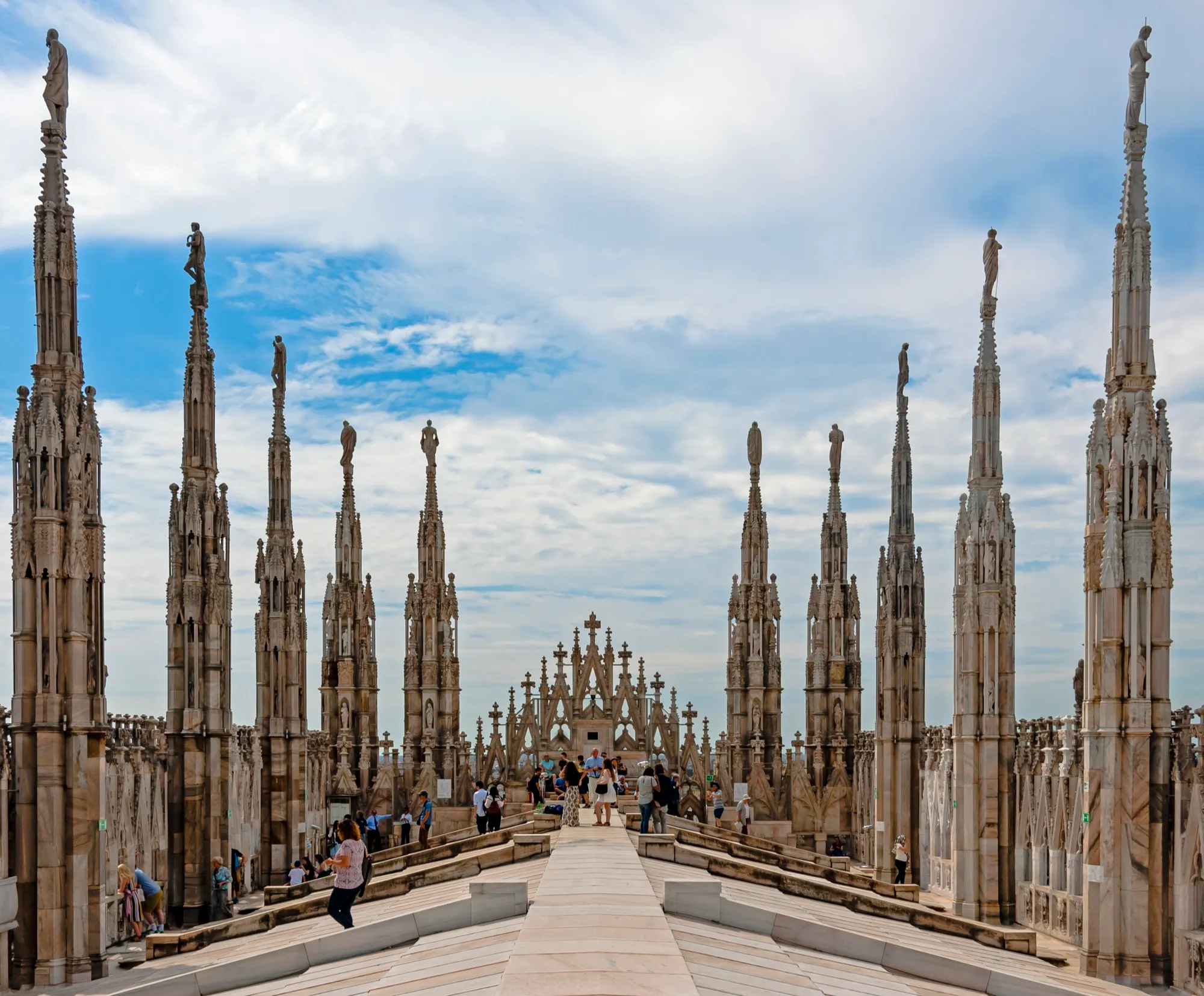
- The Duomo: tickets are timed, and there are no fees for buying online. The rooftop by lift costs €26 with the cathedral. See our Duomo tickets guide.
- The Pinacoteca di Brera: reservations are required, including on the free first Sunday of the month.
Dress code in churches
Cover your shoulders and legs to enter the Duomo. Its ticket pages show this rule for the cathedral and the rooftop. Pack a light scarf or long trousers for church visits on hot days.
Monday closures
Plan your Monday carefully in Milan. These are closed:
- the Last Supper museum
- the Pinacoteca di Brera
- the Sforza Castle museums (the courtyards stay open)
The Duomo Museum closes on Wednesdays instead.
Safety: watch for pickpockets
The US State Department rates Italy at Level 2, “Exercise increased caution”. Its main everyday warning is pickpocketing in crowds, on buses and metros, and in train stations. In Milan, the area around Centrale station has more pickpocketing than other parts of the city.
Keep your phone out of back pockets, wear your bag in front on crowded trains, and keep valuables in a zipped pocket.
Meal times and aperitivo
The Milanese aperitivo usually runs from about 6pm to 9pm: a drink with snacks before dinner. In the usual areas, such as the Navigli and Porta Venezia, expect to pay €10 to €20. Dinner comes after it.
Water
Tap water in Milan is safe to drink. It is tested by the city water company and the local health authority. Bring a refillable bottle.
Where to stay
For a first trip, the area around the Duomo puts you within walking distance of the main sights. Our where to stay in Milan guide compares the neighborhoods, with prices and safety notes.
Frequently asked questions
Do Americans need a visa or ETIAS for Italy in 2026?
No visa is needed for stays of up to 90 days in any 180-day period. As of October 2026, ETIAS is not in operation and no application is needed. The EU will announce the start date several months in advance, and the fee will be €20.
How long must my passport be valid to visit Italy?
At least 3 months beyond the date you plan to leave the Schengen area, and it must have been issued within the last 10 years.
What is the EES and will it affect me?
The Entry/Exit System has been fully running since 10 April 2026. On your first entry, border staff take your fingerprints and a photo of your face in place of a passport stamp.
Should I tip in Italy?
Tipping is not expected. Restaurants may charge a coperto (cover charge) per person, which must be shown on the menu. Rounding up for good service is a kind extra, not an obligation.
Do I need to stamp my train ticket in Italy?
Only paper regional tickets, which you validate in the station machine before boarding. High-speed tickets are for a set train and seat and need no stamping, and digital regional tickets activate automatically.
What is the emergency number in Italy?
112. It is free from any phone and reaches police, ambulance and fire services anywhere in the EU.