Quick answer
Milan’s metro has five color-coded lines, M1 to M5, run by ATM. One ride costs €2.20 and is valid for 90 minutes, and you can skip the ticket machine by tapping a contactless card or phone at the gate: ATM caps the charge at €7.60 a day. Trains run from about 5:30am to about 12:30am, and the blue M4 goes straight to Linate Airport.
Fares, hours and payment rules below were checked on 5 October 2026 on the official sites of ATM, Milan’s transit company, and of Linate Airport.
Milan metro lines and map
Each line has a number and a color, and the signs in the stations use both. Trains are labeled with the name of the last station, so check the terminus on the map before you walk onto a platform.
| Line | Color | Runs between | Useful stops for visitors |
|---|---|---|---|
| M1 | Red | Sesto 1° Maggio FS and Rho Fieramilano or Bisceglie | Duomo, Cairoli, Cadorna, Conciliazione, San Babila |
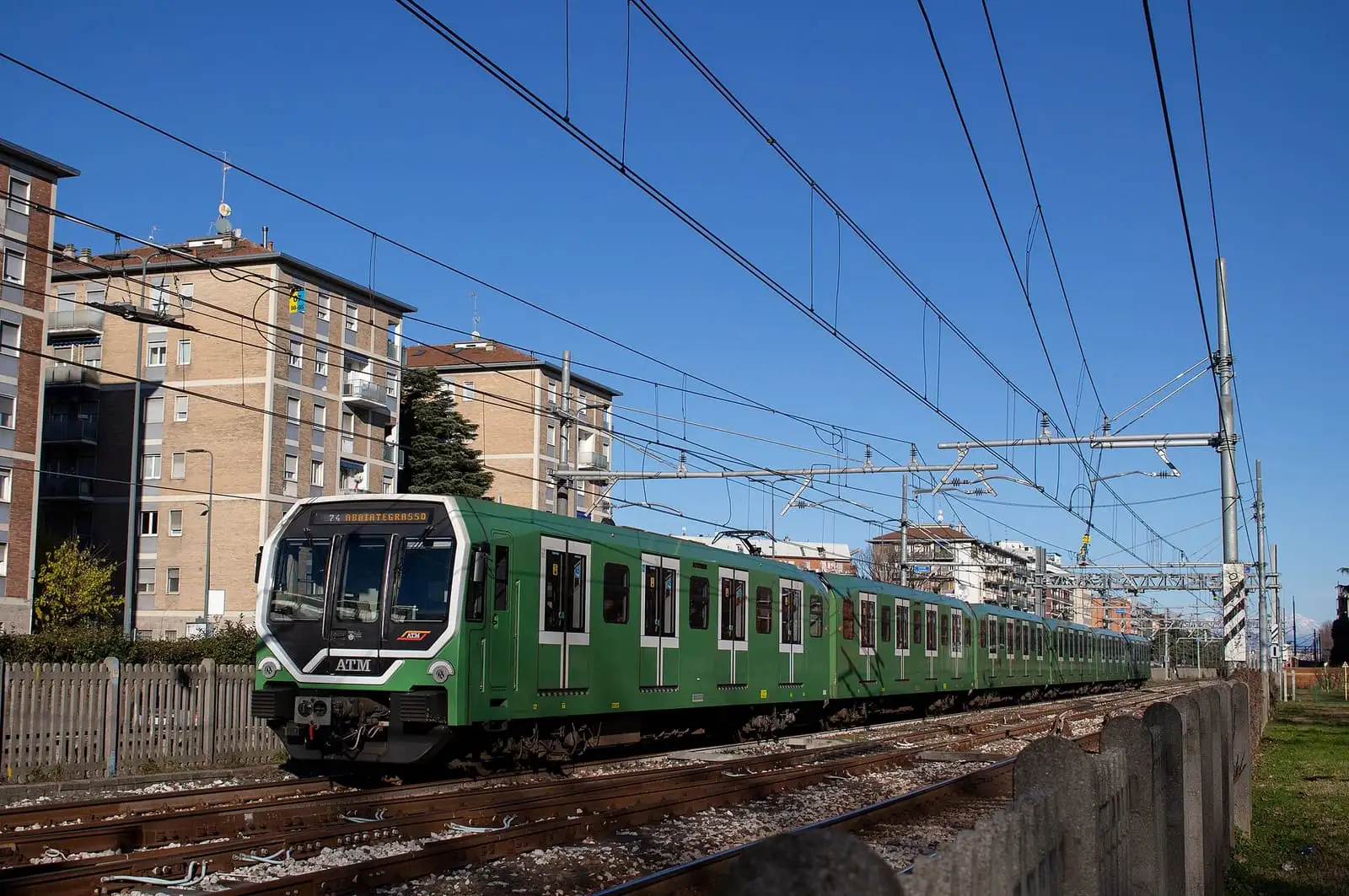
| M2 | Green | Gessate or Cologno Nord and Abbiategrasso or Assago Forum | Centrale, Garibaldi, Lanza, Cadorna, Sant’Ambrogio, Porta Genova |
| M3 | Yellow | Comasina and San Donato | Centrale, Repubblica, Montenapoleone, Duomo |
| M4 | Blue | Linate Aeroporto and San Cristoforo | Linate Aeroporto, San Babila, Sant’Ambrogio |
| M5 | Lilac | Bignami and San Siro Stadio | Garibaldi, Isola, Monumentale, San Siro Stadio |
The M1 and M2 split into branches at their ends. Before you board, read the destination on the front of the train and on the platform screen, especially on the M1 going west (Rho Fieramilano or Bisceglie).
The main interchanges are Duomo (M1 and M3), Cadorna (M1 and M2), Loreto (M1 and M2), Centrale (M2 and M3), Garibaldi (M2 and M5), San Babila (M1 and M4) and Sant’Ambrogio (M2 and M4). ATM publishes the official metro and rail map, which also marks the stations with lifts. The M4 and M5 are driverless.
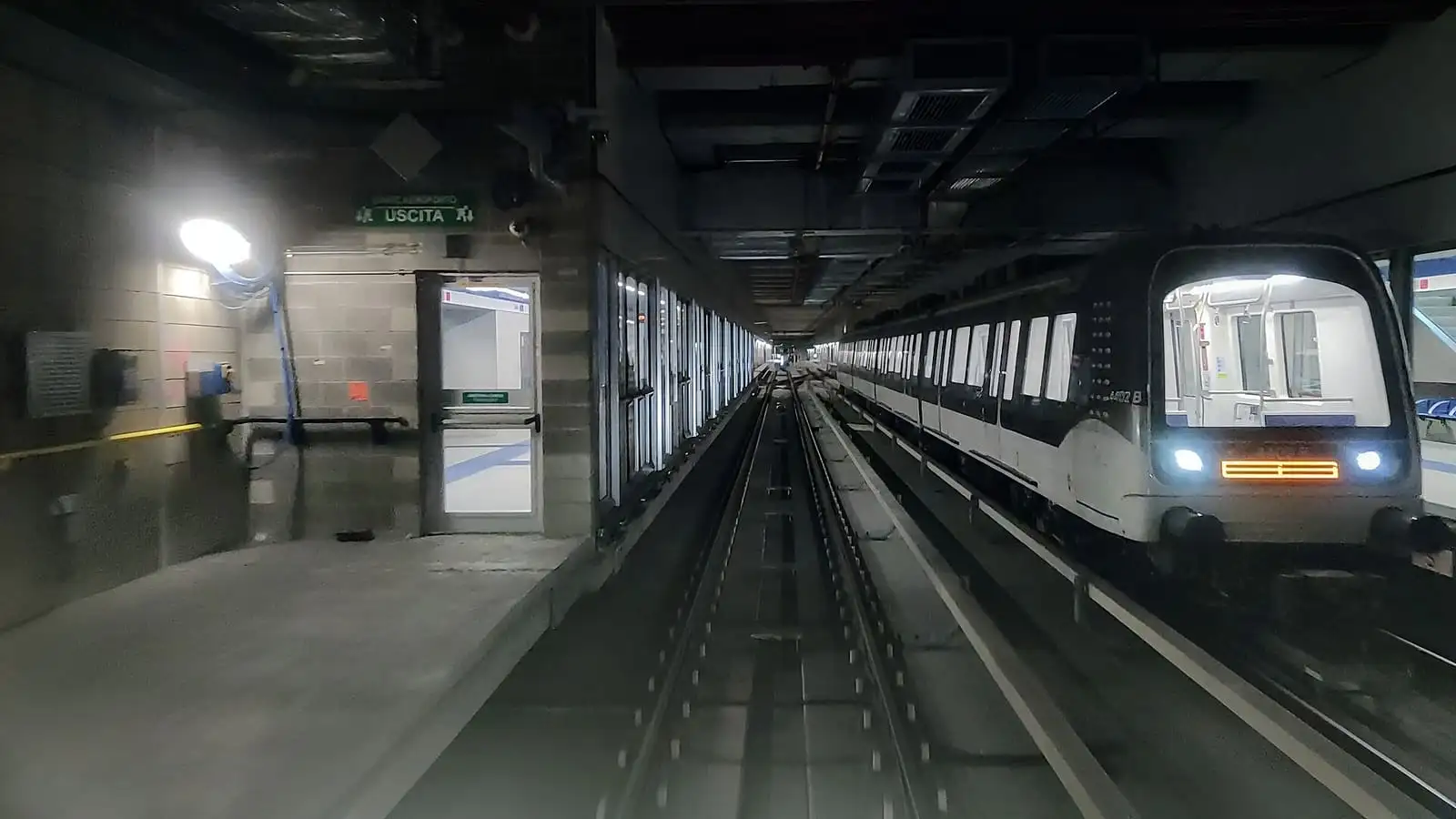

A driverless train on the blue M4 line, which opened in stages between 2022 and 2024.
How much is a metro ticket in Milan
The same tickets work on the metro, trams, buses and the Trenord S lines inside the city (fare zones Mi1 to Mi3, which cover all of Milan).
| Ticket | Price | Valid for |
|---|---|---|
| Ordinary ticket | €2.20 | 90 minutes from the first validation |
| Single-day ticket | €7.60 | 24 hours from the first validation |
| 3-day ticket | €15.50 | Until the end of service on the third day |
| 10-trip carnet | €19.50 | Ten 90-minute tickets, one person at a time |
| Contactless card | €2.20 per trip | Capped at €7.60 per day |
Within the 90 minutes you can leave the metro and enter again on the same ticket. There is no 48-hour or weekly ticket for visitors, so for a two-day stay a contactless card is usually the simplest choice. Children under 14 ride free; carry an ID for them.
The standard ticket also covers the trips visitors ask about most: Linate Airport on the M4, the Fiera Milano exhibition center at Rho Fieramilano (M1) and the Unipol Forum at Assago Forum (M2). One exception: on the M2 branch toward Gessate, the city ticket is valid only as far as Cascina Burrona.
MilanoCard, a private city pass, includes the metro, trams and buses plus discounts on attractions. It costs €15 for one day and €30 for three. For transport alone, ATM’s own €7.60 day ticket and €15.50 3-day ticket cost about half as much.
How to pay: contactless, the ATM app or RicaricaMi
You have three ways to pay, and the old paper tickets are gone: they expired on 31 December 2025.
Contactless card or phone. Tap a contactless Visa, Mastercard, American Express, Maestro or VPay card, or Apple Pay or Samsung Pay, on the reader at the gate. There is no fee and no registration. ATM charges a €2.20 fare for each 90-minute journey and, from the fourth journey within 24 hours, charges the €7.60 day fare instead. The charge reaches your statement a few days later. Prepaid Postepay cards and PagoBancomat debit cards are not accepted.
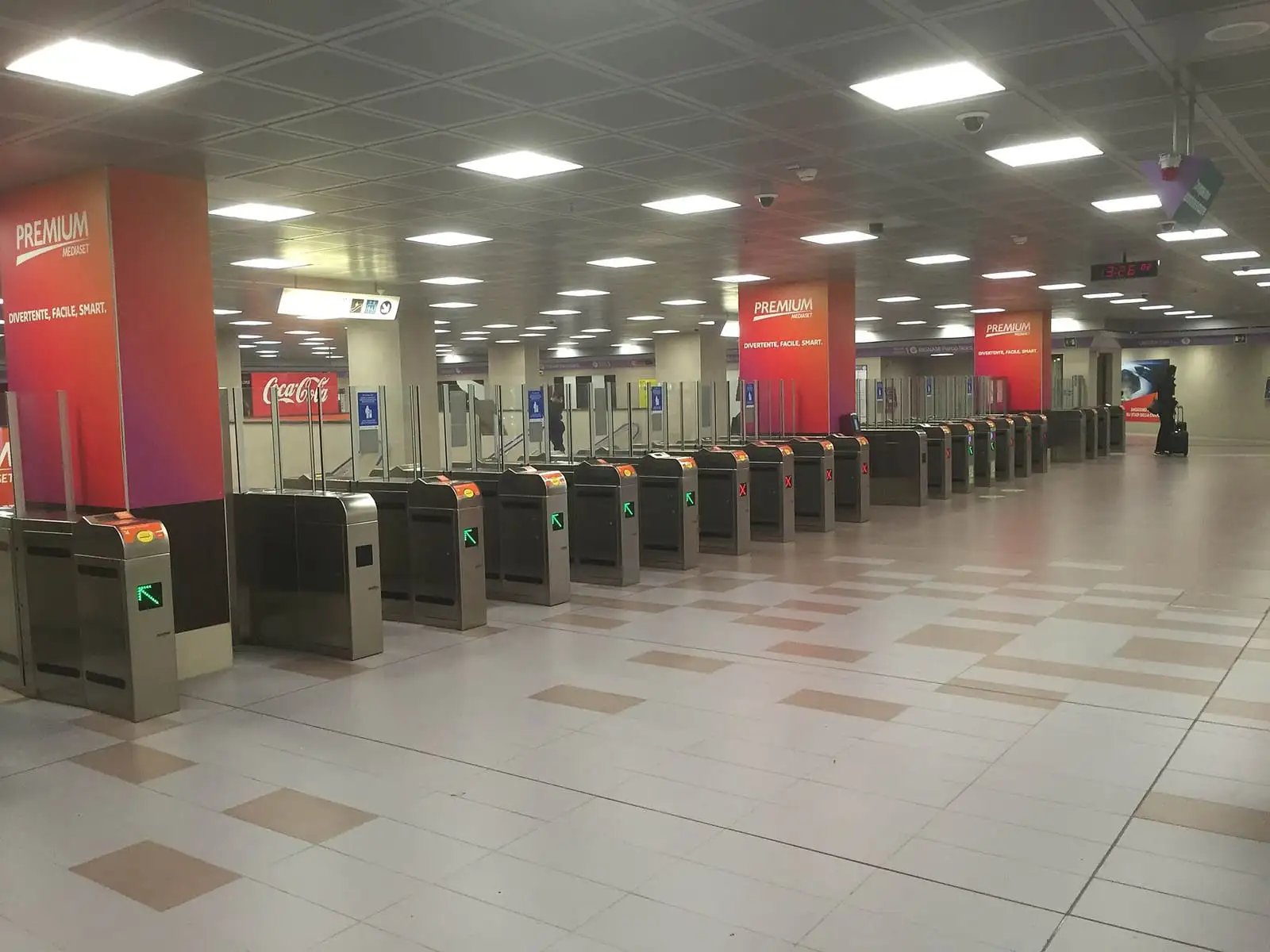
.JPG)
The ticket gates at San Siro Stadio station on the M5, where you tap in on the way in and tap out on the way out.
A few rules matter:
- Tap out at the end of every metro ride with the same card or phone, even when the exit gates stand open. If you do not, ATM charges the highest fare from your entry station.
- One card per person. A card or phone pays for one passenger at a time, so each traveler needs their own.
- Use the same card all day. Switching between your card and your phone means the system cannot apply the daily cap.
- Hold out only one card. The readers pick up any card, pass or phone, so do not tap a whole wallet.
- Every station has at least two gates that take contactless payment. If one reader fails, try another.
ATM app. You can buy single, day, 3-day and carnet tickets with a card, PayPal or Satispay. Validate the ticket in the app before you start, then hold the QR code about 5 cm from the reader at the gate, going in and out. Do not delete or update the app during a trip: you lose the tickets you have validated.
RicaricaMi. This reloadable card replaced paper tickets. Buy and top it up at the machines in metro stations or at newsstands, and touch it on the reader (do not insert it). It holds up to 30 ordinary tickets, or one day or 3-day ticket, and one person uses it at a time. The machines in M4 stations take cards only.
If your ticket runs out while you are underground, the exit gate will not open. Buy an exit ticket from the machine before the turnstiles. ATM inspectors check tickets with a handheld device: show them the same card or phone you tapped.
How to ride the metro, step by step
- Find your line color and the name of the terminus in your direction on the station signs.
- Tap your card or phone, or scan your app ticket, at the gate.
- Follow the signs to the platform for that terminus and check the screen before boarding.
- To change lines, follow the color of the next line. You stay inside the gates, so there is no second tap.
- Tap out with the same card or phone when you leave.
On the escalators, stand on the right and keep the left free for people walking. It is my first piece of advice to any American visiting Milan: at rush hour the left side moves fast, and standing there blocks commuters running for a train.
Google Maps and the ATM app both plan metro routes, and the ATM app sends updates on the status of the metro lines, which helps on strike days.
Metro hours and night buses
| Line | First train | Last train | How often in the daytime |
|---|---|---|---|
| M1, M2, M3 | About 5:30am | About 12:30am | Every few minutes at peak times |
| M4 | 5:40am (6am Sundays and holidays) from Linate | 12:26am from Linate, 12:20am from San Cristoforo | Every 1 to 3 minutes on weekdays, 4 to 6 on Sundays |
| M5 | 5:40am (6am Sundays and holidays) from Bignami | 12:01am from Bignami | Every 3 to 4 minutes on weekdays, 4 to 6 on weekends |
The M4 and M5 times are from ATM’s timetables valid from 15 March 2026. For the M1, M2 and M3, treat 5:30am and 12:30am as approximate and check the first and last trains from your station in the ATM app. Summer timetables with fewer trains apply for part of July and August, on dates that change every year.
After the metro closes, ATM runs a network of night buses inside the city on the same tickets. On the M4 route, the NM4 night bus links Linate Airport and San Cristoforo.
Metro stops for Milan’s main sights
Most sights in the center are close together, and you can walk between many of them. The metro helps for the longer hops:
- DuomoMap and the Galleria Vittorio Emanuele IIMap: Duomo (M1, M3). Our Duomo tickets guide explains which ticket to buy.
- The Last Supper at the Museo del Cenacolo VincianoMap: Conciliazione (M1), or Cadorna (M1, M2). Book ahead with our Last Supper tickets guide.
- Sforza CastleMap: Cairoli (M1), Lanza (M2) or Cadorna. See our Sforza Castle guide.
- Pinacoteca di BreraMap and the Brera streets: Lanza (M2) or Montenapoleone (M3).
- The Navigli canals and the DarsenaMap: Porta Genova (M2). Our Navigli guide covers the canals and the evening scene.
- Basilica di Sant'AmbrogioMap: Sant’Ambrogio (M2, M4).
- Bosco VerticaleMap and Porta Nuova: Garibaldi (M2, M5) or Isola (M5).
- Cimitero MonumentaleMap: Monumentale (M5).
- San Siro stadiumMap: San Siro Stadio, the M5 terminus. On match days, see AC Milan and Inter tickets for the route to your sector. GetYourGuide sells San Siro stadium and museum tours.
A hotel near a station with two lines saves you changes. Duomo (M1, M3), Cadorna (M1, M2) and Centrale (M2, M3) are the most useful, and you can compare hotels near the Duomo on Booking.com. Our guide to where to stay in Milan lists the nearest stations for each area. For a full plan built around these stops, see one day in Milan or 2 days in Milan.
The metro to the airports and train stations
Linate is the only airport on the metro. The M4 reaches the center in about 12 minutes on a €2.20 ticket; our guide to Linate to Milan has the details, plus the buses to Centrale.
Malpensa is not on the metro. Take the Malpensa Express from Cadorna (M1, M2) or Centrale (M2, M3), which needs its own train ticket because ATM contactless does not work on Trenord trains. Our Malpensa to Milan guide compares the train, buses and taxis, and Milan’s airports explains which one you are likely to use.
Train stations. Milano Centrale is on the M2 and M3, four stops from Duomo on the yellow line; the Milano Centrale guide shows where the metro entrance is. Porta Garibaldi is on the M2 and M5, and Cadorna, for the trains to Como, is on the M1 and M2.
Accessibility
All M4 stations and most stations on the other lines have lifts and escalators. The older M1, M2 and M3 are less consistent than the M4 and M5, and lifts do go out of service. ATM shows the live status of every lift and stairlift on its accessibility page and in the app, and its help line (+39 02 48 607 607, then 1) can plan an accessible route with you. Platforms have intercoms to reach staff, with SOS buttons on the M4 and M5.
With large suitcases, use the lifts where they work and avoid the busiest interchanges at rush hour.
Is the Milan metro safe?
The metro is busy and generally safe, and the main problem is pickpocketing. The US State Department lists pickpocketing on buses, metros and in train stations as its main everyday warning for Italy, and police have arrested pickpockets at Duomo metro station.
- Keep your bag zipped and in front of you in crowded cars and on escalators.
- Keep phones and wallets out of back pockets.
- Late at night, when the metro has closed, take a white taxi from a rank or book one through an app such as FREENOW or appTaxi rather than accepting a ride from someone who approaches you. Our taxis in Milan guide has the fares.
Our first trip to Italy guide covers money, cards and the rest of the safety basics, and how much a trip to Italy costs puts the metro fares in a daily budget.
Frequently asked questions
How much is a metro ticket in Milan?
A single ticket costs €2.20 and lasts 90 minutes on the metro, trams and buses. A 24-hour ticket costs €7.60 and a 3-day ticket €15.50. [Children under 14 ride free](/things-to-do/milan-with-kids/) with an ID.
Can I use my credit card on the Milan metro?
Yes. Tap a contactless Visa, Mastercard, American Express, Maestro or VPay card, or Apple Pay or Samsung Pay, on the gate going in and again going out. ATM charges the cheapest fare and switches to the €7.60 day fare from your fourth trip in a day.
Do you have to tap out on the Milan metro?
Yes, with the same card or phone you used to enter, even if the exit gates are open. If you do not tap out, ATM charges the highest fare from your entry station.
What time does the Milan metro close?
Most trains stop around 12:30am. On the M4 the last train from Linate leaves at 12:26am, and on the M5 the last train from Bignami leaves at 12:01am. Night buses run after that, including the NM4 on the M4 route.
Does the Milan metro go to the airport?
Only to Linate. The blue M4 line reaches the city center in about 12 minutes on a standard €2.20 ticket. For Malpensa you need the Malpensa Express train or a bus, which the metro ticket does not cover.
Can two people use one contactless card on the Milan metro?
No. Each card or device pays for one passenger at a time, so every traveler needs their own card, phone or ticket.
Are paper metro tickets still sold in Milan?
No. The old single-use paper tickets expired on 31 December 2025. Use a contactless card, a ticket in the ATM app, or the reloadable RicaricaMi card sold at machines and newsstands.
Is MilanoCard worth it for the metro?
Only if you will use its discounts. MilanoCard costs €15 for one day and €30 for three days, while ATM's own day ticket is €7.60 and its 3-day ticket €15.50.