Quick answer
A ticket to the Sforza Castle museums costs €10 and covers every museum inside for the day. The courtyards are free daily from 7am to 7:30pm, and the museums are free for everyone on the first Sunday of the month. Leonardo’s Sala delle Asse is closed for restoration in 2026.
Prices, hours and closures below were checked on the castle’s official website and its official ticket shop on 5 October 2026.
Sforza Castle tickets and prices
Sforza Castle (Castello Sforzesco)Map is run by the City of Milan, and one ticket gets you into all its museums for the whole day, with one entry per section. You can buy it at the museum ticket office or on the official ticket shop, where you pick an entry time and can buy up to 9 tickets. Shop prices already include the booking fee.
| Ticket | Price | Who qualifies |
|---|---|---|
| Full | €10 | Everyone 18 and over without a discount |
| Reduced | €5 | 65 and over, university students, EU citizens aged 18 to 25 |
| Free | €0 | Under 18, visitors with disabilities and one companion |
| Open-date full | €11 | Online only, use within 12 months |
| Merlate Panoramiche (battlements) | €10 (€5 reduced) | Separate ticket, not included |
The 18 to 25 discount applies to EU citizens and to non-EU visitors only where there is a reciprocity agreement, so Americans in that age group should expect to pay €10. The 65-and-over discount has no nationality condition on the official page.
Free visitors still need a ticket. Online, choose “ingresso omaggio” (free entry), and bring ID because staff check discounts at the door. Tickets are not refundable.
Free entry: first Sunday and the under-25 Tuesday
The castle museums have two free days a month:
- First Sunday of every month, free for everyone. You cannot book online for that day: get your free ticket at the museum ticket office. The next ones are 1 November and 6 December 2026.
- Second Tuesday of every month, free for visitors up to 25. The official shop does not limit this rule to EU citizens. The next dates are 13 October, 10 November and 8 December 2026.
If you plan to see several of Milan’s civic museums, the Tourist Museum Card costs €20 and gives one entry to each of them, Sforza Castle included, for 3 consecutive days from first use.
Opening hours
The museums open Tuesday to Sunday, 10am to 5:30pm. The ticket office closes at 4:30pm, and 4:30pm is also the last entry to each museum section. They are closed every Monday and on 25 December, 1 January and 1 May.
The courtyards are open every day from 7am to 7:30pm, Mondays included. The Infopoint inside keeps the museum days, Tuesday to Sunday, 9:30am to 5:30pm.
The official ticket shop warns that on 8 October 2026, between 10am and 2pm, some or all sections may not be open because of a staff meeting. Some rooms can also close at short notice, so check the castle’s notices page on the day.
A short history of Sforza Castle
Galeazzo II Visconti built the first fortress here between 1360 and 1370. It was partly demolished during the short-lived Ambrosian Republic (1447 to 1450) and rebuilt by Francesco Sforza. Under Galeazzo Maria Sforza and Ludovico il Moro it housed one of the most lavish courts in Europe, at the time Leonardo da Vinci and Bramante were working in Milan.
The Spanish, Austrian and French rulers of Milan then used it as a barracks, from 1535 to 1859. At the end of the 1800s the architect Luca Beltrami restored and partly rebuilt it, and turned it into a home for the city’s museums.
What to see, museum by museum
The castle holds several separate museums along one route, all on the same ticket.
.jpg)
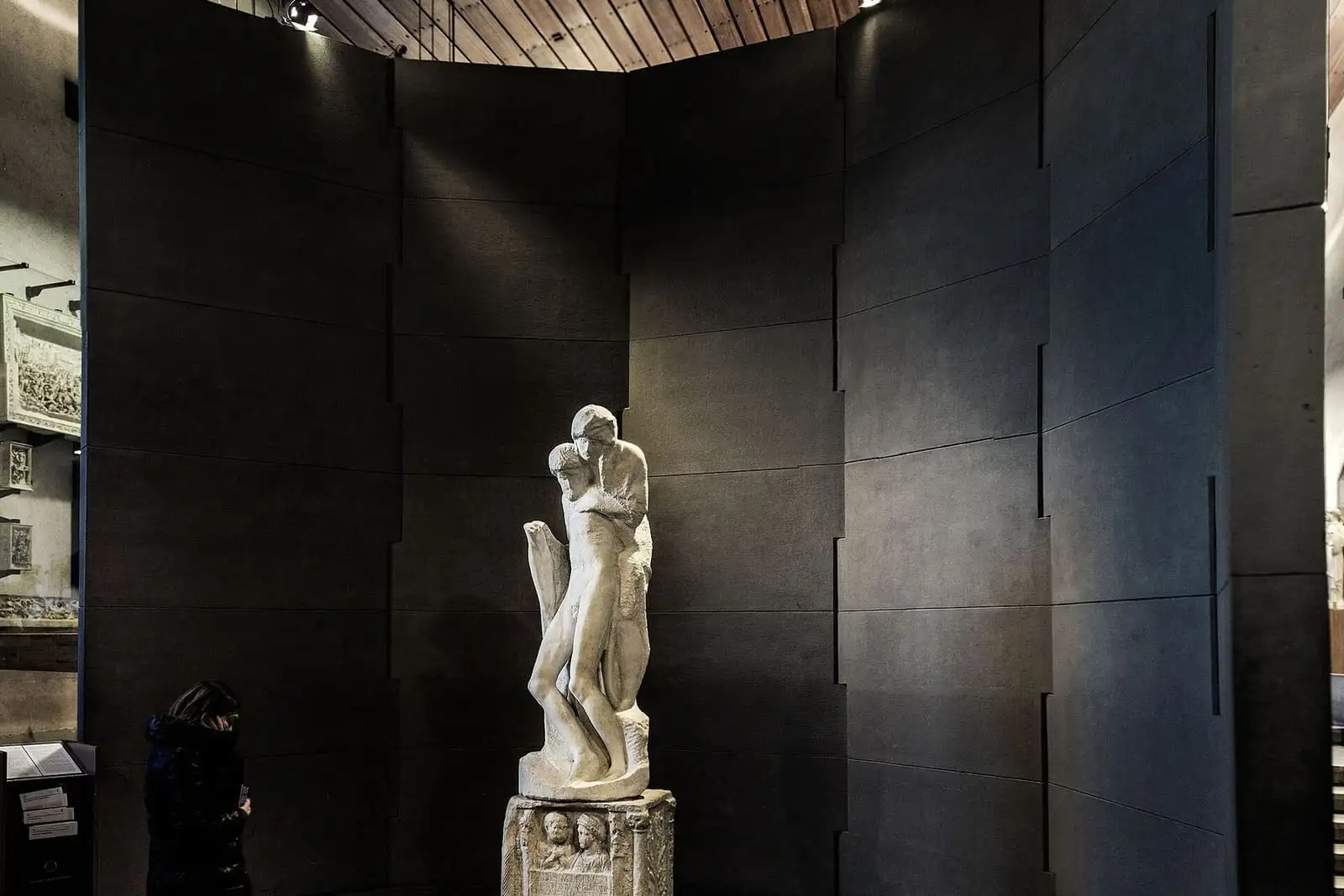
Michelangelo's Rondanini Pietà in its earlier display; since 2015 it stands in the castle's former Spanish Hospital.
Rondanini Pietà museum
Michelangelo carved this marble Pietà in the last ten years of his life, and it is his final work. He died in 1564. Since 2015 it has had its own museum in the old Spanish Hospital, a room where sick soldiers were nursed in the 1500s, with verses of the Creed painted on the vault. You can walk all the way around the statue.
Museum of Ancient Art and the Armoury
About 400 sculptures from the 5th to the 16th century fill the old ducal apartments, including the gilded equestrian tomb of Bernabò Visconti. The Ducal Chapel, frescoed in 1473, is on this route. The Armoury at the end shows European armour, swords and firearms from the late 1300s to the 1800s.
Sala delle Asse (closed in 2026)
Leonardo da Vinci painted this room as a pergola of 18 intertwined trees across the vault. It is closed for restoration, and the official ticket shop lists it as closed. Guided visits on the scaffolding ran only from 7 February to 14 March 2026. Milan’s culture councillor has said the goal is to reopen in April 2027; treat that as a target. Pinacoteca room XXI, dedicated to painters trained by or influenced by Leonardo, reopened in January 2026.
Pinacoteca
Lombard painting from the 1400s to the 1700s, with works by Mantegna, Bellini, Correggio, Canaletto, Foppa and Bramantino. Look for Mantegna’s large altarpiece of the Virgin in glory with four saints, signed and dated 15 August 1497. Foppa’s Madonna del Libro is off display for maintenance as of October 2026.
Egyptian gallery
Sarcophagi, amulets, mummies and a statue of the pharaoh Amenemhat III, partly from 1930s excavations in the Fayum. It is included in the main ticket, but the €5 audio guide does not cover it.
Musical Instruments Museum
About 900 instruments, plus the RAI electronic music studio used in Milan from 1955 to 1983. The same route passes through the Sala della Balla, hung with Bramantino’s 12 Trivulzio tapestries of the months, finished in 1509.
The other collections
The Furniture and Decorative Arts museums are also on the ticket, with design pieces by Gio Ponti and Ettore Sottsass and Murano glass. The prehistory section of the Archaeological Museum is closed for re-display.
The Merlate battlements walk
The Merlate Panoramiche let you walk a stretch of the castle’s covered patrol walkway, with views over the city. You need a separate ticket, €10 full or €5 reduced, sold online or at the Merlate desk inside the castle Infopoint. Children up to 5 go free, with tickets issued at the desk.
Entry runs Tuesday to Sunday with last entry at 5pm. Groups of up to 25 people go up together with a staff member, and the visit itself is self-guided. You climb the Rocchetta courtyard staircase, more than 100 steps, or use the lift for reduced mobility and strollers. The route is about 300 metres, step-free and roofed, so it works in the rain.
The underground passage, the Strada Coperta della Ghirlanda, is only open on guided tours run by Ad Artem, the castle’s official tour partner, for ages 10 and up. In October they run on Saturdays at 11am and Sundays at 4pm.
The courtyards (free)
You enter through the Filarete tower into the Cortile delle Armi, the big first courtyard. Along one side the castle displays late-Roman stone sarcophagi, statue fragments and two Renaissance facades salvaged from demolished buildings in central Milan. Beyond it are the Corte Ducale, with a portico from 1473, and the Rocchetta courtyard.
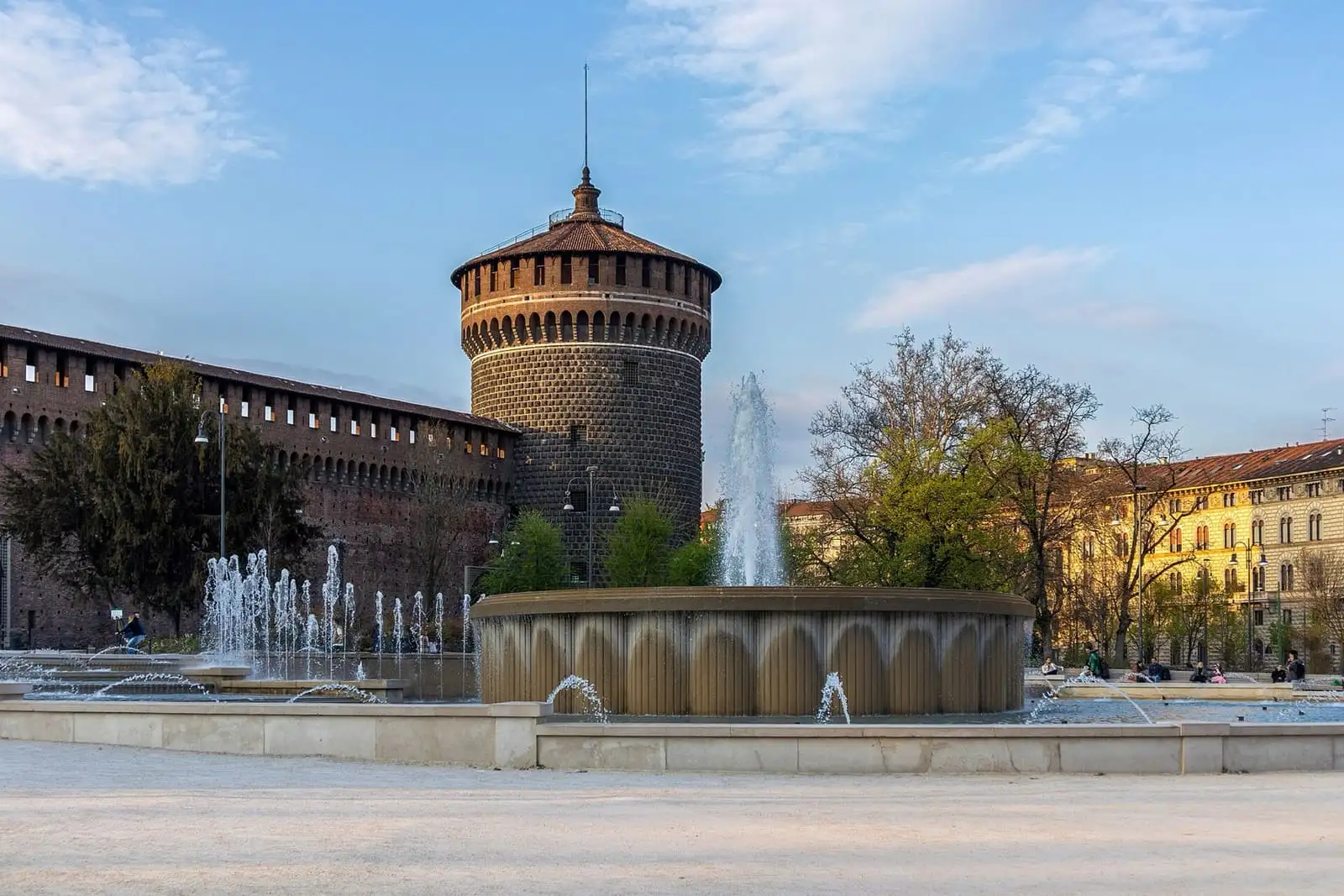
The Filarete tower itself is a reconstruction. The original, designed by Filarete in 1452, collapsed in June 1521 after it had been turned into a gunpowder store. Beltrami rebuilt it from old drawings and documents, and the new tower was inaugurated in 1905.
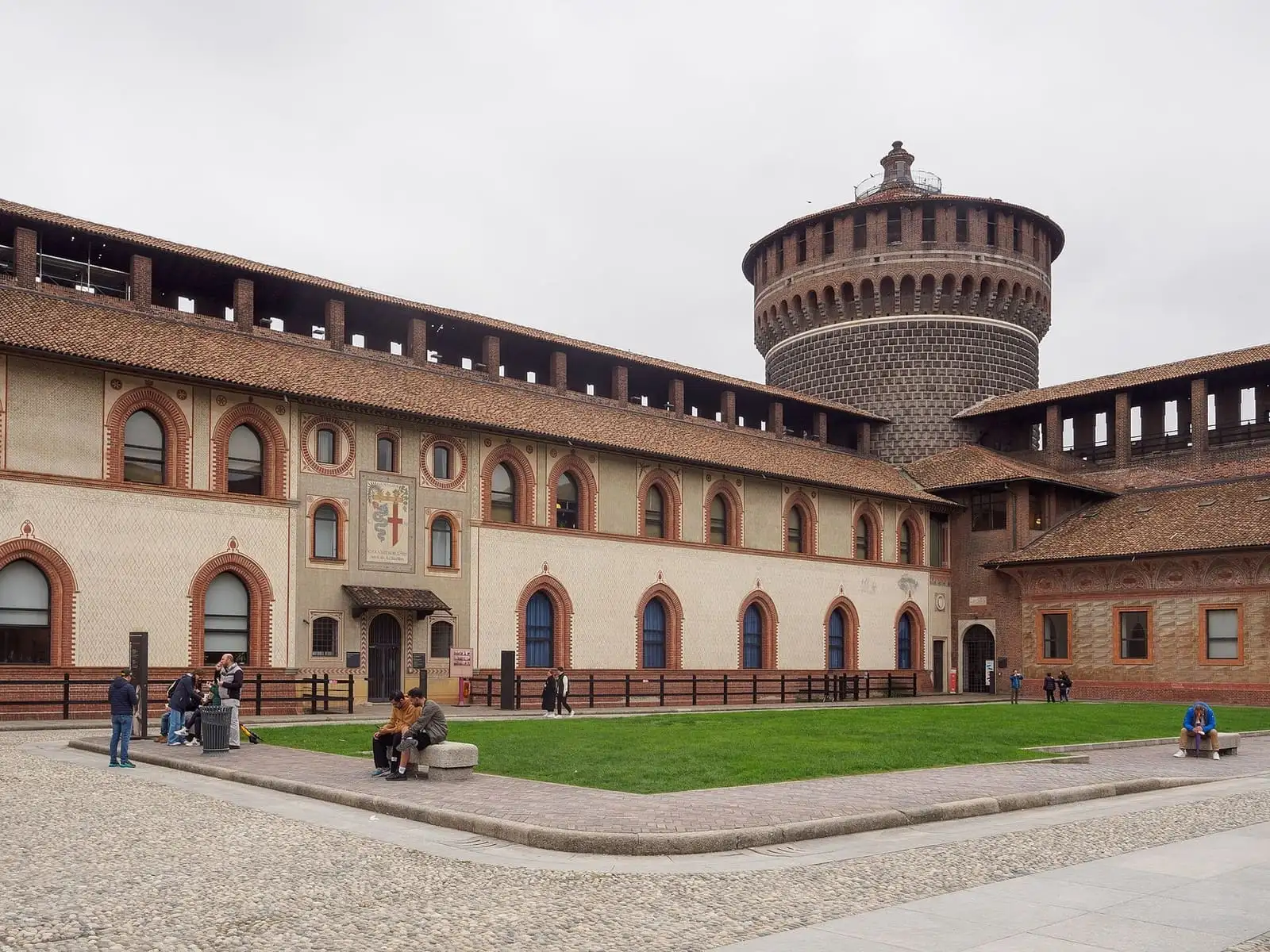

The Cortile delle Armi, the first courtyard inside the castle walls.
All of this is free from 7am to 7:30pm daily, which makes the castle an easy stop on a Monday, when the museums are closed. Dogs are allowed in the outdoor spaces only.
How long to spend
The castle gives no official visit time. As a guide, plan 2 to 3 hours if you want the Rondanini Pietà, the Ancient Art museum with the Armoury, and the Pinacoteca, and add the Merlate walk on top. If you only cross the courtyards on the way to the park, 30 minutes is enough.
The museums are easier to follow with some help. The €5 audio guide from the bookshop comes in English, and the official guided tour in English runs every Saturday at 11am. That tour costs €20 including the museum ticket, needs no booking and meets at 10:45am at the Infopoint.
The official ticket is the cheapest way in. If you want a guide booked in advance with a set meeting time, compare Sforza Castle tickets and guided tours on GetYourGuide, where each listing shows its own cancellation policy.
How to get to Sforza Castle
The castle is at Piazza Castello. The nearest metro stops are Cairoli on the red M1 line, Lanza on the green M2, and Cadorna FN on both. From the DuomoMap it is about 1.2 km on foot, roughly a 16-minute walk, or you can ride the M1 to Cairoli. Trams 1, 2, 4, 12 and 14 and buses 50, 57, 58 and 85 also stop nearby.
For lunch, I skip the restaurants toward the Duomo and go to Il PoliticoMap, the sandwich kiosk at Piazza Castello 5, by the castle entrance. Its panini are named after politicians. It is open every day from 10:30am to midnight.
Large bags and backpacks go in lockers next to the ticket office. There is a café by the Corte Ducale, open 10am to 6:30pm on museum days, and most of the museum route is wheelchair accessible, with wheelchairs available at the ticket office. Photography for personal use is allowed in the museums.
Combining the castle with Parco Sempione and the Last Supper
Parco SempioneMap lies behind the castle and stretches to the Arco della Pace, so you can walk through the courtyards and into the park. The park opens daily at 6am and closes at 10pm from October to March, at midnight from April to September. On weekend afternoons, look for the drummers: percussionists gather with bongos and djembes at Arman’s Accumulazione musicale e sedutaMap, a 1973 artwork shaped like a small amphitheatre behind the park’s basketball court, and people sit on the steps to sing along. In the other direction, the Pinacoteca di BreraMap is about 0.8 km from the castle, an 11-minute walk.
The Last SupperMap is a 15-minute walk away, which makes the two an easy half day. Last Supper tickets are the hard part, so book those first and fit the castle around your time slot: our guide to Last Supper tickets explains how. For a full day plan with the Duomo as well, see one day in Milan and our Duomo tickets guide. With more time, our 2 days in Milan itinerary gives the castle a full morning, battlements included, and our guide to the best things to do in Milan covers the rest of the city.
Frequently asked questions
How much are Sforza Castle tickets?
A full ticket costs €10 and covers every museum in the castle for the day, including the Egyptian gallery. The reduced ticket is €5 for visitors 65 and over, university students and EU citizens aged 18 to 25. Under 18s go free but still need a ticket.
Is Sforza Castle free to enter?
The courtyards are free every day from 7am to 7:30pm. The museums are free for everyone on the first Sunday of the month, and free for visitors up to 25 on the second Tuesday of the month.
Is the Sala delle Asse open?
No. Leonardo's Sala delle Asse is closed for restoration as of October 2026. The city's stated target is to reopen it in April 2027, but no official date has been set.
What are Sforza Castle's opening hours?
The museums open Tuesday to Sunday, 10am to 5:30pm, with the ticket office closing at 4:30pm. They are closed on Mondays, 25 December, 1 January and 1 May.
Is the battlements walk included in the museum ticket?
No. The Merlate Panoramiche walk has its own ticket (€10 full, €5 reduced) and runs Tuesday to Sunday with last entry at 5pm. Groups of up to 25 go up with a staff member.
How long do you need at Sforza Castle?
There is no official figure. Two to three hours is a reasonable plan for the Rondanini Pietà, the Ancient Art museum and the Pinacoteca, and about 30 minutes is enough for the courtyards alone.
Can you take photos inside Sforza Castle?
Yes, for personal use. The castle's official FAQ allows photography in the museums as long as it is not for profit.