Quick answer
Milan’s Monumental Cemetery (Cimitero Monumentale) is a free open-air museum of tombs and sculpture, open Tuesday to Sunday from 8am to 6pm (last entry 5:30pm) and closed on Mondays. Take the M5 to Monumentale, start at the Famedio, then find the Campari Last Supper, the Toscanini tomb and the spiral Bernocchi chapel.
Hours, tour dates and rules as of 16 November 2026.
What the Monumental Cemetery is
The Cimitero MonumentaleMap opened on 2 November 1866, designed by the architect Carlo Maciachini to replace the small cemeteries scattered around the city. It covers 245,000 square metres north of the centre. For 150 years Milan’s industrial and cultural families commissioned their tombs from leading sculptors, so a walk here takes you through Realism, Symbolism, Liberty (Italian Art Nouveau), the Novecento and Rationalism in one afternoon.
It is still a working cemetery, with funerals and families visiting their graves.
Opening hours and free entry
Entry is free and individual visitors don’t book.
| Day | Hours | Last entry |
|---|---|---|
| Tuesday to Sunday | 8am to 6pm | 5:30pm |
| Monday | Closed (open if the Monday is a public holiday) | |
| 1 Jan, Easter Sunday and Monday, 1 May, 2 Jun, 15 Aug, 8, 25 and 26 Dec | 8am to 1pm | 12:30pm |
The church inside, the Santissimo Crocefisso, keeps shorter hours and closes for the whole of August. The cemetery’s own information is on the official Monumentale website, run by the City of Milan.
Because it is closed on Mondays, like the Last Supper and most civic museums, plan it for another day. Our guide to free things to do in Milan has other free sights that open on Mondays.
Free guided tours, map and Infopoint
The City runs free guided tours with its own staff and civil service volunteers. The general route lasts about 90 minutes and meets at the Infopoint, under the first portico on the left after the main gate. Wear comfortable shoes: the paths are gravel.
To book, email [email protected] with:
- the date and time you want, chosen from the calendar on the tours page;
- the route (general or themed);
- the number of people (two at most, unless you are close family);
- a phone number and two alternative dates.
Your place is confirmed only when you get a written reply. The tours run mostly on weekends and fill up fast. There are none in November 2026; the December dates are Saturdays 5, 12 and 19 December at 2:30pm and Sundays 6, 13 and 20 December at 10:30am. The page doesn’t say which language each tour is in, so ask in your email.
If you miss out, there are two simpler options:
- Monumentale su due piedi. A free 20-minute introduction to the cemetery and the Famedio, Tuesday to Sunday from 9am to 4pm. No booking: ask at the Infopoint. Up to five people at a time.
- Self-guided. Paper maps (in Italian) are at the gatehouse to the left of the main entrance, and the website has a downloadable map of the general route. The short version covers four monuments in about 30 minutes; the full one has 16 monuments and takes about 90.
The Infopoint is open Tuesday to Sunday from 9am to 5pm. Staff there can also help you find a specific grave.
How to get there
The cemetery is on Piazzale Cimitero Monumentale, north of Brera and west of Porta Nuova.
- Metro: Monumentale (M5) is right by the square. Garibaldi FS (M2 and M5) is a short walk east. Our Milan metro guide explains tickets and lines.
- Tram: 10 (stop Monumentale M5), 12 and 14 (stop Piazzale Cimitero Monumentale / Via Bramante), 2, 4 and 33 (Via Farini).
- Bus: 70 (Via Ceresio / Monumentale M5) and 94 (Piazzale Baiamonti).
- Train: Porta Garibaldi station, including the suburban Passante lines.
Wheelchairs are available at the main gate and at the Porta Acattolici on the west side. There are public toilets at the main gate.
Tombs and monuments worth finding
Sculpted family monuments along one of the cemetery's avenues.
Pick up a map at the gate, because the monuments are spread across a large area and the sections are numbered (Riparto V, Necropoli and so on). These are the ones to look for, in the order of the official general route.
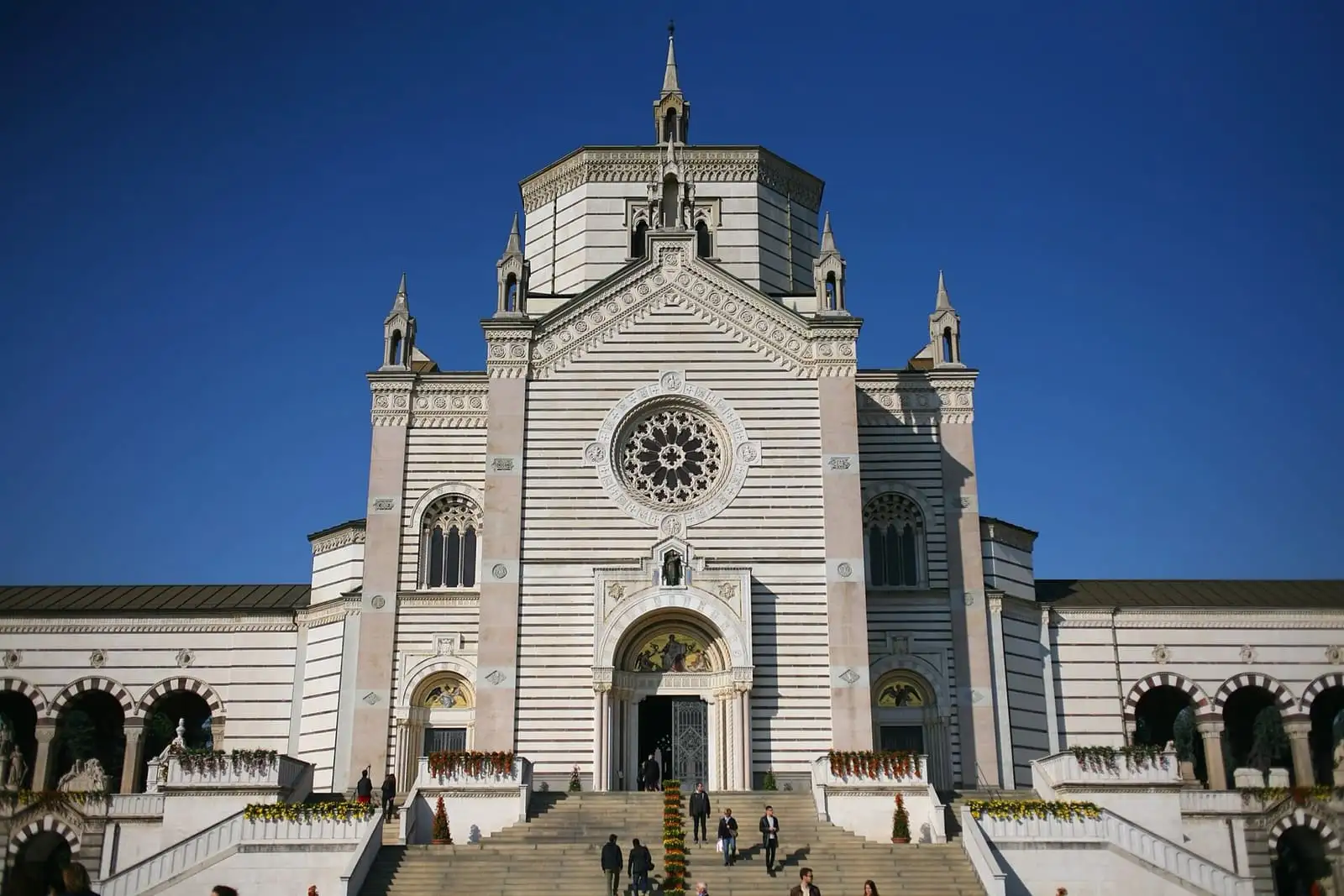
- The Famedio. The striped marble “Temple of Fame” facing the square is where Milan honours its great citizens. Only eight people are buried in the main hall: Alessandro Manzoni, author of The Betrothed, lies at the centre in a sarcophagus designed by Maciachini, and the others include Carlo Cattaneo, Luca Beltrami, Salvatore Quasimodo, Bruno Munari and, since 2021, the ballerina Carla Fracci. Plaques remember others buried elsewhere, such as Giuseppe Verdi.
- The Famedio crypt. Entered from the porticoes at the entrance, it holds Dario Fo and Franca Rame, Giorgio Gaber, Alda Merini, Enzo Jannacci and the cartoonist Guido Crepax.
- Memorial to the victims of the Nazi camps. In the open space where the main avenues meet, the BBPR architects built a white metal grid around a glass case holding earth from Mauthausen. The names of more than 800 Milanese victims are carved at the base. Gian Luigi Banfi, one of the four architects, died at Mauthausen in 1945.
- The Toscanini tomb. Leonardo Bistolfi carved it in 1909-1911 for the conductor’s son Giorgio, who died before turning five. On one side, three Fates holding a thread watch over a cradle. Arturo Toscanini, who died in New York in 1957, was buried here after a funeral at La Scala, and so was his son-in-law, the pianist Vladimir Horowitz.
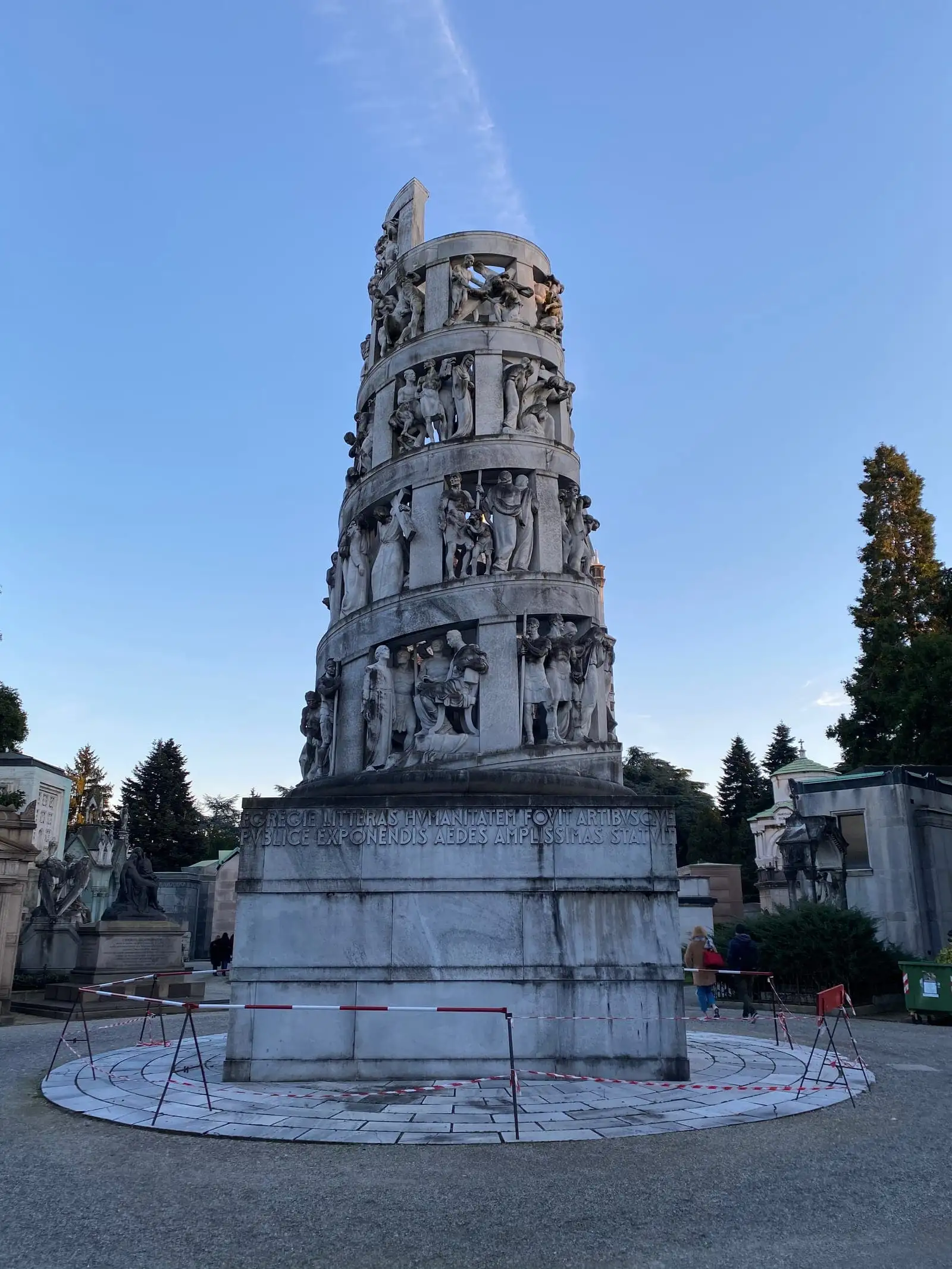
- The Bernocchi chapel. At the centre of the Necropoli, a stone cone rises in a spiral, wrapped in 30 marble scenes of the Passion by Giannino Castiglioni. Antonio Bernocchi’s bequest to the City paid for the Triennale building.
- Lucio Fontana’s angel on the Chinelli monument. A small, easily missed piece from 1949, behind the Falck chapel: a glazed ceramic angel with traces of its original gilding, made the year after Fontana launched Spatialism.
- The Campari Last Supper. Davide Campari, whose father Gaspare began making bitter in Milan around 1865, commissioned a bronze Last Supper from Castiglioni for his family tomb. It stands on a porphyry boulder at the end of the avenue between the raised Ponente sections, facing the arches.
- The Jewish section. Opened in 1872 on the east side, with its own gate (Porta Israelitici). The largest and oldest family monuments are in the northern part, near rows of small identical stones in the common fields. The Jewish Community of Milan looks after it.
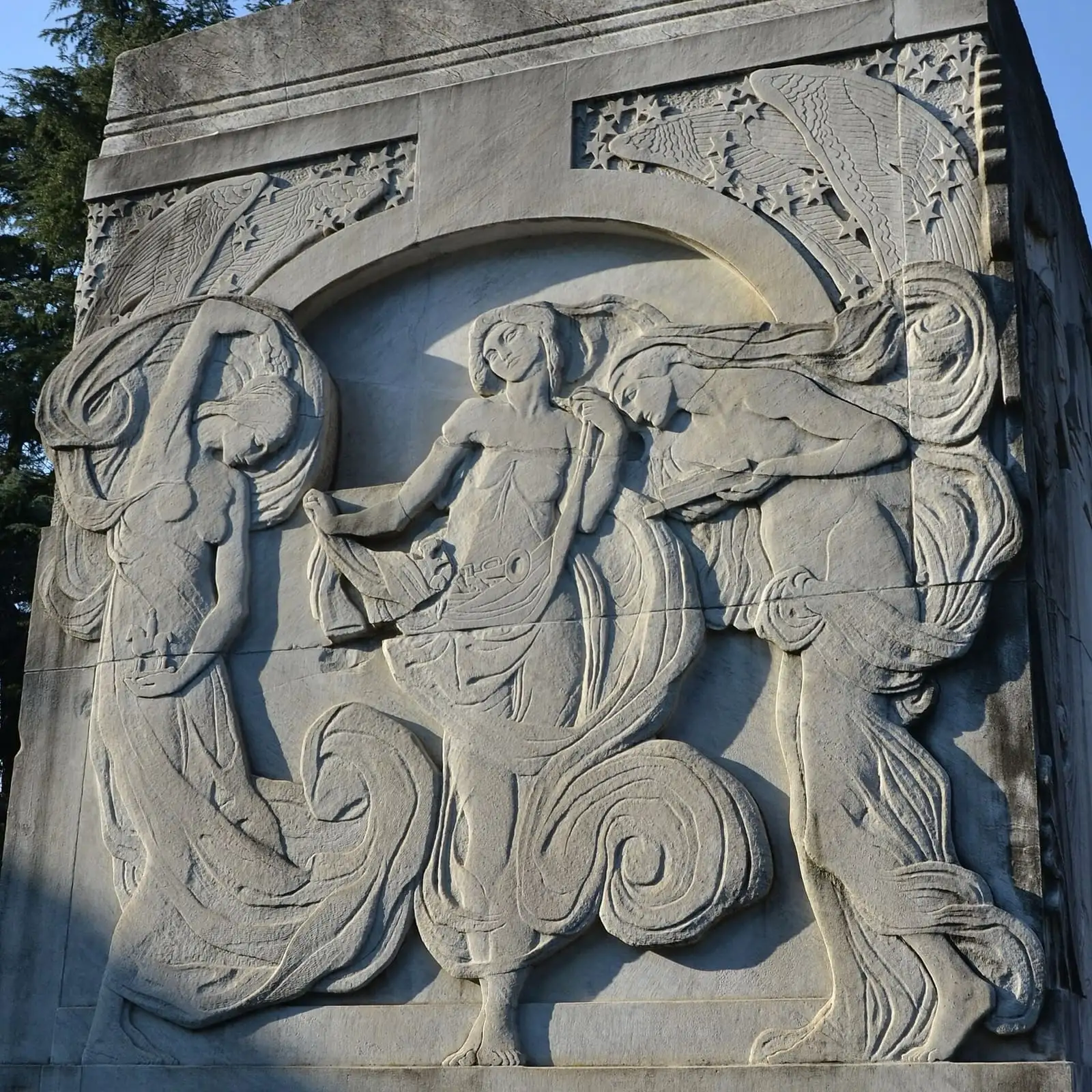

Bistolfi's three Fates holding a thread, on the side of the Toscanini tomb.
If you have time, the general route adds the Palanti civic mausoleum, two tombs by the sculptor Adolfo Wildt (Körner and Chierichetti), the Bocconi family chapel and the Tempio Crematorio on the north edge, built in 1875.
Photography and etiquette
The cemetery’s rules cover organised shoots: photo, film and video projects need written permission from the management at least 30 days ahead, shoots happen only on Mondays when the gates are closed, and requests to use the cemetery as a backdrop for photo shoots are turned down. For quick pictures of the monuments as a visitor:
- Dress as you would in church. The City asks visitors to wear clothes that respect the place.
- Keep your voice down and step aside for funerals and people visiting their family graves. Never photograph mourners.
- Don’t climb, sit or lean on tombs, and don’t touch the sculptures.
- Leave flowers and objects on graves where they are.
- Use the gravel paths; don’t walk across burial plots.
Chinatown and Isola nearby
The cemetery sits between two of Milan’s best neighbourhoods for an evening, so it makes a good afternoon stop before dinner.
Chinatown (Via Paolo Sarpi). A 9-minute walk south-west brings you to Via Paolo Sarpi, the main street of Milan’s Chinatown. At number 27, La Ravioleria SarpiMap sells dumplings from a counter every day, and most people eat them on the street. A few steps away at number 30 is Cantine IsolaMap, a wine bar open since 1896, every day from 10am to 10pm. It’s my pick for a glass after the cemetery: you order at the counter and drink it outside on the street with everyone else.
Isola. The Isola district is about 18 minutes on foot to the north-east, or two stops on the M5. On the way you pass the Biblioteca degli AlberiMap park and the Bosco VerticaleMap towers, which you see from the street. Our Milan restaurants guide has places to eat in Isola.
Also next to the cemetery, Fondazione SozzaniMap on Via Enrico Tazzoli holds exhibitions with free entry; you book your visit online.
For more off-the-list ideas like this one, see our guide to unique things to do in Milan.
Frequently asked questions
Is the Monumental Cemetery in Milan free?
Yes. Entry is free and individual visitors do not need to book. The City of Milan also runs free guided tours of about 90 minutes, which you book by email.
What are the Monumental Cemetery opening hours?
Tuesday to Sunday from 8am to 6pm, with last entry at 5:30pm. It is closed on Mondays unless the Monday is a public holiday, and on 1 January, Easter, 1 May, 2 June, 15 August and 8, 25 and 26 December it closes at 1pm.
What is the most famous graveyard in Milan?
The Cimitero Monumentale, opened in 1866. Its Famedio holds the tomb of the novelist Alessandro Manzoni, and its family chapels include the bronze Last Supper on the Campari tomb and Bistolfi's Toscanini monument.
What is the most famous cemetery in Italy?
In Milan it is the Monumentale. Elsewhere in Italy, Genoa's Staglieno is the other great cemetery of sculpted tombs; Giuseppe Mazzini is buried there and remembered with a plaque in Milan's Famedio.
Who is buried in the Monumental Cemetery?
Alessandro Manzoni, Carlo Cattaneo and Carla Fracci in the Famedio; Dario Fo and Franca Rame, Giorgio Gaber, Alda Merini and Enzo Jannacci in its crypt; and Arturo Toscanini and the pianist Vladimir Horowitz in the Toscanini family tomb.
Can you take photos in the Monumental Cemetery?
Organised photo, film and video shoots need written permission from the cemetery management, requested at least 30 days ahead, and take place only on Mondays. Requests to use the cemetery as a backdrop for photo shoots are refused, so keep your camera to quick, discreet pictures of the monuments.
How long do you need at the Monumental Cemetery?
The City's short route covers four monuments in about 30 minutes, and the main route covers 16 monuments in about 90 minutes. Allow an hour to wander on your own.
What are some historical sites to visit in Milan?
The Duomo, the Last Supper at Santa Maria delle Grazie, the Sforza Castle, the Basilica of Sant'Ambrogio, the Galleria Vittorio Emanuele II and La Scala. The Monumental Cemetery adds 150 years of Milanese history told through its tombs.