Quick answer
Italy uses plug types C, F and L at 230 volts and 50 Hz. A type C adapter fits almost every Italian socket and is enough for phones and laptops, which already accept 100-240V. For US-only 120V devices such as many hair dryers, buy a dual voltage model.
The US uses flat-pin plugs and 120 volts; Italy uses round pins and 230 volts. That’s two different problems: the plug shape, which an adapter solves, and the voltage, which only matters for some devices. This guide explains both, shows what Italian sockets look like and lists the adapters worth packing. Products were checked on Amazon.com on 28 October 2026.
Plug types in Italy: C, F and L
Italy uses three plug types, and you will meet all of them:
| Type | What it looks like | Where you find it |
|---|---|---|
| C (Europlug) | Two thin round pins, no ground | Phone and small chargers all over Europe |
| F (Schuko) | Two thicker round pins, metal clips on the sides | Round, recessed sockets, common in hotels and new buildings |
| L (Italian) | Three round pins in a line | Small three-hole sockets, in two sizes: 10 amp and 16 amp |
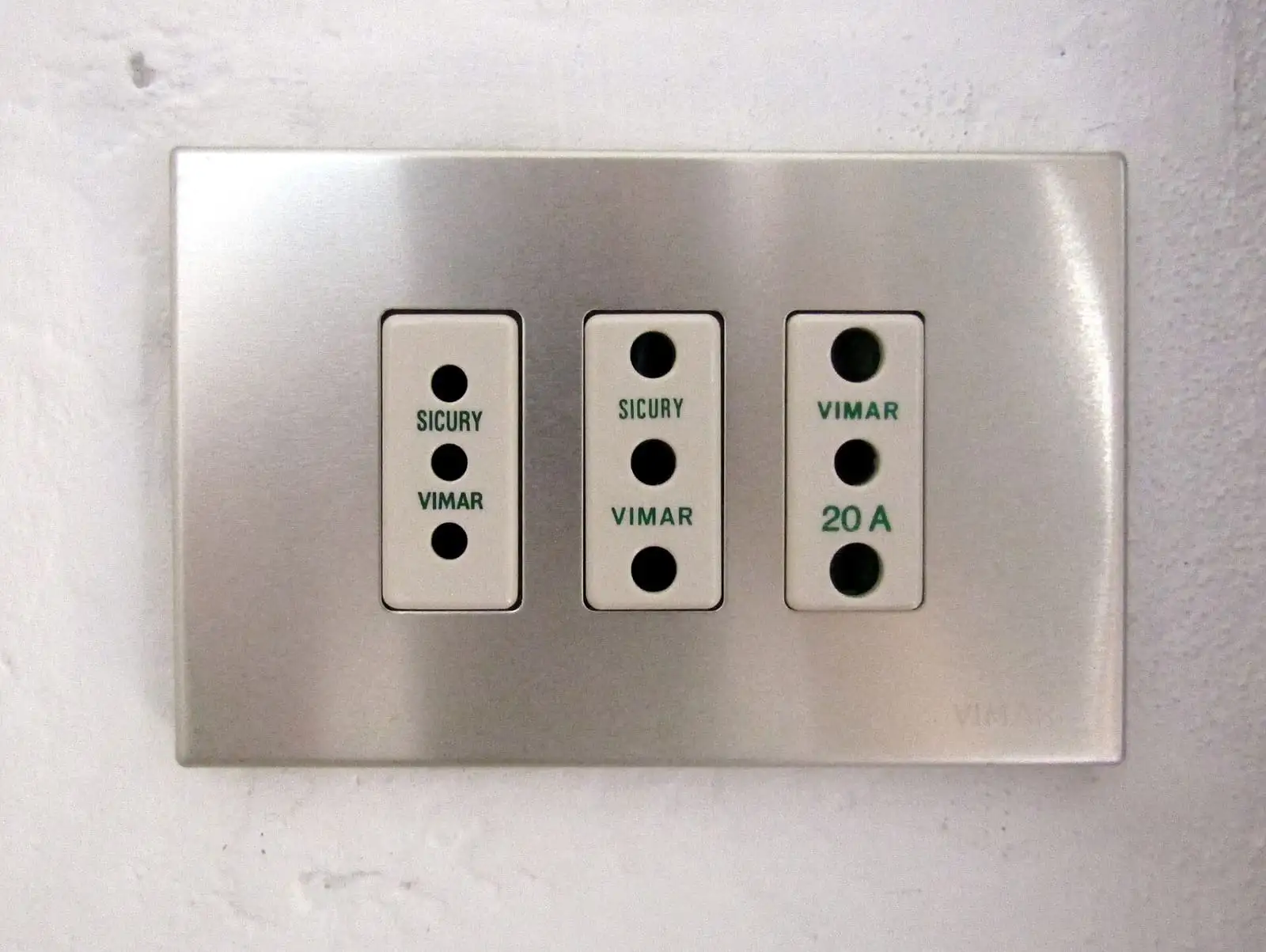

Italian type L sockets in three sizes, with the three holes in a line.
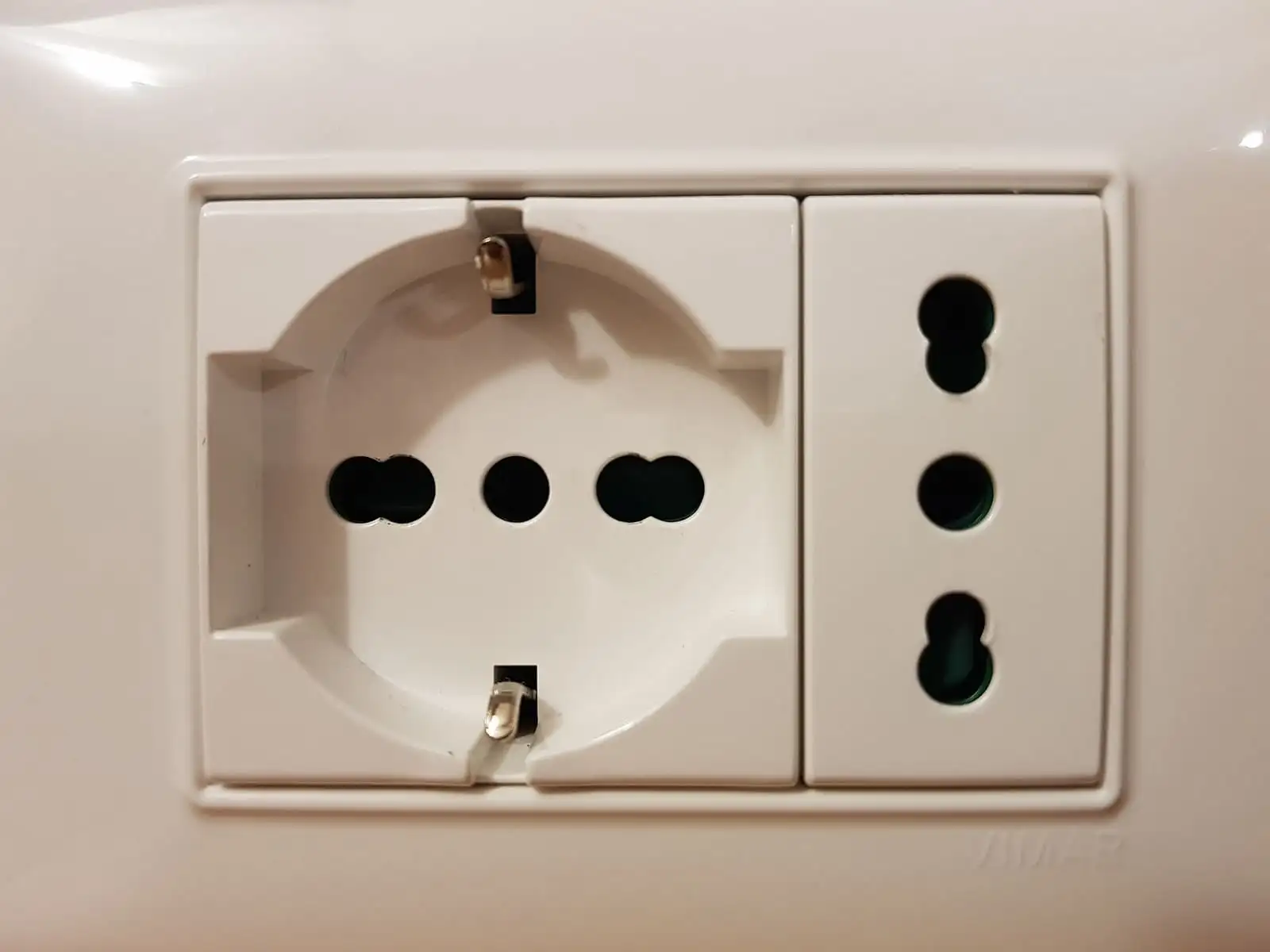
Type L comes in two sizes that don’t fit each other: the 10 amp plug has thinner pins set closer together, the 16 amp plug thicker and wider ones. Bipasso sockets solve this by taking both, and Italy also has combined wall plates with a Schuko socket next to a bipasso, as in the photo at the top of this page.
Which adapter to buy
The two-pin type C plug fits Schuko sockets, bipasso sockets and the small 10 amp type L sockets. That makes a type C adapter the one that works almost everywhere in Italy, and also in the rest of continental Europe if your trip continues to France or Spain.
Check price on AmazonA type C adapter has no ground pin. If you travel with a laptop or another device with a three-prong US plug, add a type L adapter with a grounded socket, such as the Ceptics type L adapter. It fits type L and bipasso sockets, but not a Schuko-only socket, so carry one of each.
Check price on AmazonIf your room has few free sockets near the bed, an adapter that turns one socket into several US outlets and USB ports, like the TESSAN 7-in-1 type C adapter or the TESSAN type L version, charges a phone, a watch and a camera at once. Neither converts voltage.
If Italy is one stop on a longer trip that includes the UK, a universal adapter like the EPICKA covers more than 200 countries with sliding plugs, at the cost of a bulkier block.
Do you need a voltage converter in Italy?
For most electronics, no. Look at the label on the charger, next to the word INPUT:
- 100-240V: works in Italy with a plug adapter only. This is the case for iPhone chargers (Apple says its USB adapters take 100 to 240 volts), most Android, laptop and camera chargers.
- 120V only: the device will overheat or burn out on Italian 230V power. It needs a voltage converter, or stays at home.
The usual problem is hair tools. Many US hair dryers, curling irons and straighteners are 120V only, and small travel converters are not made for them: the BESTEK converter, for example, handles up to 250 watts and its listing excludes hair dryers. The simpler fix is a dual voltage model:
- Conair dual voltage hair dryer, 1600 W, folding handle.
- Kristin Ess dual voltage straightener, a 3-in-1 flat iron that also curls.
Some dual voltage tools have a switch you must move to 230V before plugging in. Check it every time, especially after a trip back home.
A short checklist before you fly
- One type C adapter per person, plus one type L with a ground if you bring a three-prong laptop.
- Read the INPUT line on every charger: 100-240V is fine.
- Leave 120V-only hair tools at home or replace them with dual voltage ones.
- A power bank for long days out, so your phone lasts through maps and tickets. Our Italy packing list has the rest of the essentials.
For the other things to sort out before your first trip, from passports to the emergency number, see first time in Italy.
Frequently asked questions
What type of adapter do I need in Italy?
A type C adapter, the two-round-pin European plug, fits almost every socket in Italy. If you want to plug in a three-prong US device such as a laptop with a grounded cord, get a type L adapter, the Italian plug with three pins in a line.
Does Italy use 2 or 3 pin plugs?
Both. Type C has two round pins, type F (Schuko) has two thicker round pins with metal clips on the sides, and type L, the Italian plug, has three round pins in a row.
What does an Italian socket look like?
Many Italian wall plates combine a round, recessed Schuko socket with a small bipasso socket that has three holes in a line, the middle one round and the outer two shaped like a figure eight. Some walls have only small three-hole type L sockets.
Do I need a voltage converter for my iPhone in Italy?
No. Apple says its USB power adapters work from 100 to 240 volts, so you only need a plug adapter. The same is true for most laptop and camera chargers, but check the INPUT line on the label.
Can I use my American hair dryer in Italy?
Only if the label says 100-240V or it has a dual voltage switch. A US-only 120V hair dryer will overheat on Italian 230V power, and small travel converters are not made for hair dryers. Pack a dual voltage model instead.
Do Italian sockets have USB ports?
Some new hotels have them, but you can't count on it. An adapter with USB-A and USB-C ports lets you charge a phone and a watch from one socket.