Quick answer
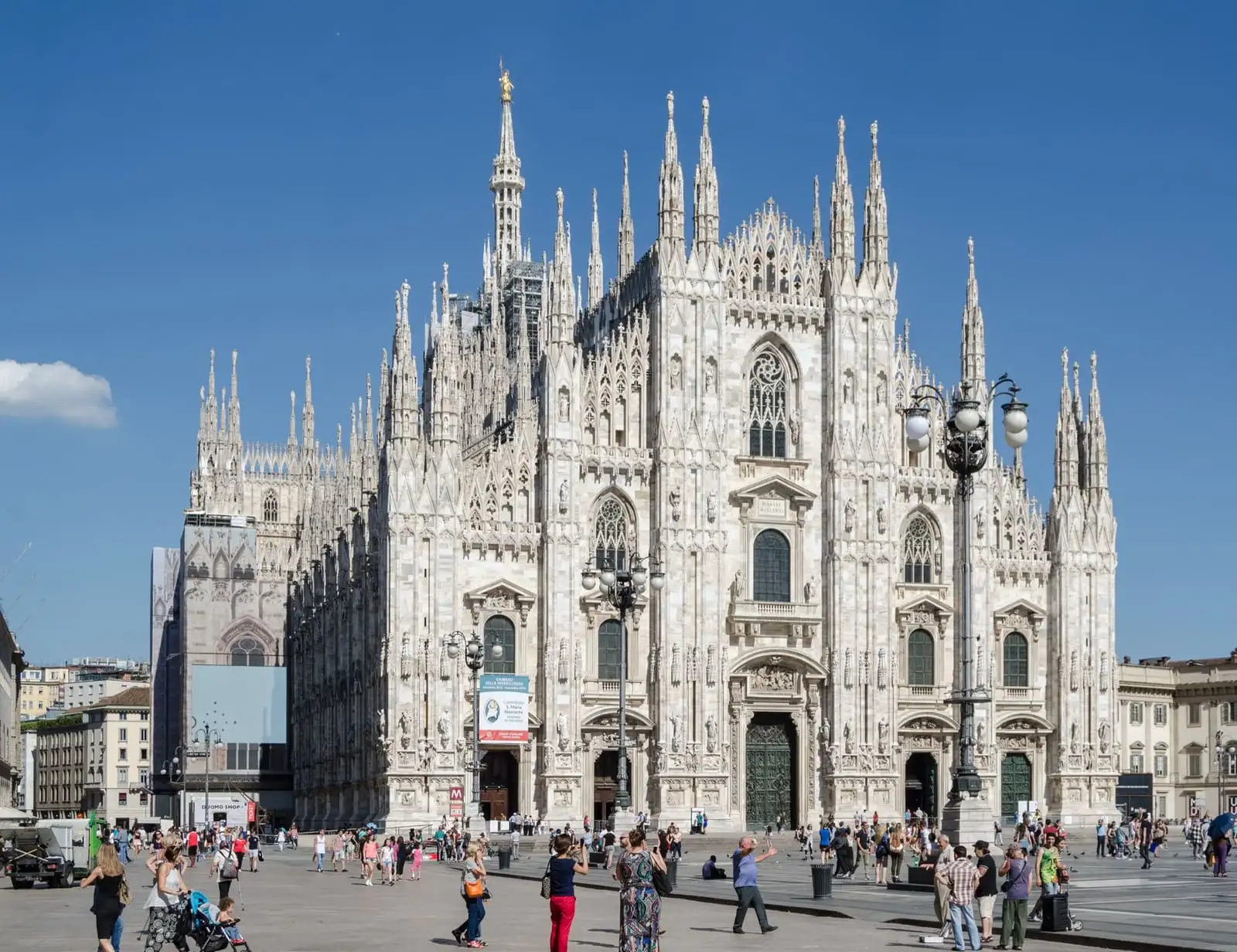
Milan Cathedral, the Duomo di Milano, is the Gothic cathedral on Piazza del Duomo, begun in 1386 and built in white and pink Candoglia marble. It is open daily from 9am to 7pm. A ticket for the cathedral and museum costs €10, and adding the rooftop terraces brings it to €22 by stairs or €26 by lift.
Hours and prices below were checked on the cathedral’s official website and ticket shop on 5 October 2026. For every ticket type and which one to choose, see our Duomo tickets guide.
Milan Cathedral at a glance
| Fact | Detail |
|---|---|
| Begun | 1386 |
| High altar consecrated | 16 October 1418 |
| Façade completed | 1807 to 1813 (doors 1909 to 1965) |
| Built and maintained by | Veneranda Fabbrica del Duomo, founded 1387 |
| Material | Candoglia marble, white streaked with pink |
| Height to the Madonnina | 108.5 m |
| Spires and statues | 135 spires, more than 3,400 statues |
| Nearest metro | Duomo (M1 red, M3 yellow) |
A short history of the Duomo
Work on the DuomoMap began in 1386 under Gian Galeazzo Visconti, lord of Milan, on the site of two older basilicas. In October 1387 he set up the Veneranda Fabbrica del Duomo to design and build the church, and the Fabbrica still looks after the cathedral today. He also chose marble and the Gothic style over the usual Lombard brick, so the Fabbrica had to bring in architects, sculptors and stonecutters from all over Europe. No single architect can be credited with the design.
The marble came from a quarry at Candoglia, near Lake Maggiore, which Gian Galeazzo gave to the Fabbrica in 1387. Blocks travelled by water: down the Toce river, across Lake Maggiore, along the Ticino and the Naviglio Grande canal into Milan, and through locks to a small dock a few hundred metres from the site. Via Laghetto, the street where that dock stood, is named after it. Marble reached Milan by water until 1920, and the Fabbrica still runs the quarry for repairs.
Building started at the apse and moved west. Pope Martin V consecrated the high altar in 1418. Late in the 1400s architects including Leonardo da Vinci submitted designs for the tower over the crossing. In the late 1500s Archbishop Carlo Borromeo reshaped the presbytery, the side altars, the crypt and the floor.
The façade took longest. Its foundations went in at the end of the 16th century, but a final design was only agreed in the late 1700s, and it was Napoleon, crowned King of Italy in 1805, who had it finished between 1807 and 1813. Most of the spires on the roof and many stained-glass windows went up in the 19th century, and the doors of the façade were added between 1909 and 1965. Restoration has never really stopped: work on the crossing tower and dome began in 2016.
What to see inside Milan Cathedral
The inside is divided into five naves by rows of huge columns, and the capitals at the top of the columns are decorated with statues. Walk the length of the church to the apse behind the high altar, where construction began, to see its stained-glass windows.
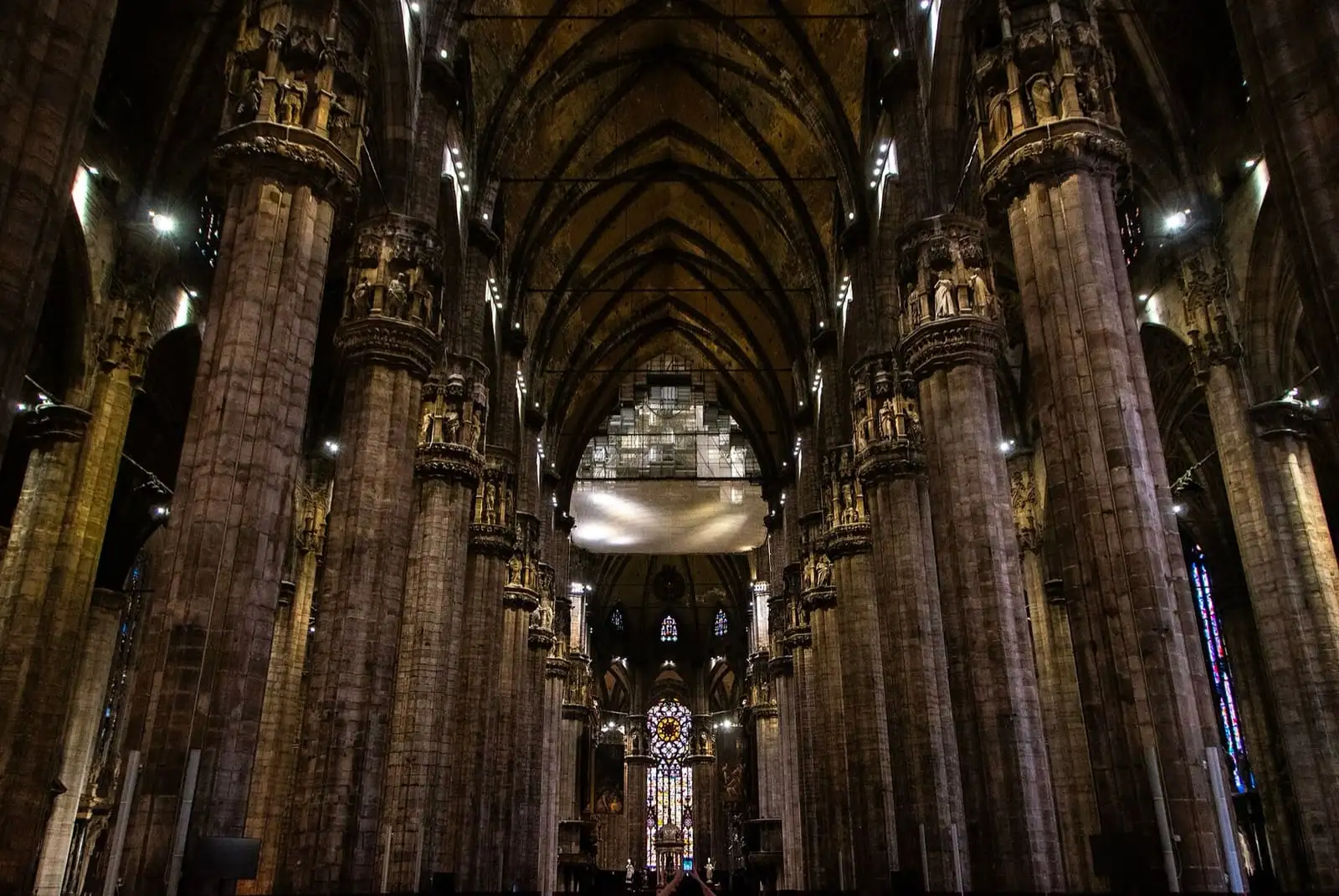

The central nave of Milan Cathedral, looking toward the high altar.
The meridian line
Just inside the main doors, a brass strip runs across the floor from south to north and continues about 3 metres up the north wall. The astronomers of the Brera Observatory laid it in 1786, when Austrian-ruled Lombardy switched to counting the day from solar noon. A hole in the roof 24 metres up lets a beam of sun fall on the line at noon. The time was then signalled to Sforza CastleMap, where a cannon was fired.
St Bartholomew Flayed
In the south transept, Marco d’Agrate’s 1562 statue shows the apostle, who was skinned alive, wearing his own skin like a cloak, with every muscle visible. The inscription at the base reads, in Latin, that Marco d’Agrate made it and not Praxiteles, the great sculptor of ancient Greece. It stood outside the cathedral until 1664.
The Holy Nail
A small red light high in the vault above the altar marks where the cathedral keeps a relic venerated as a nail from the Crucifixion. Each September, around the feast of the Holy Cross on 14 September, the archbishop is raised to the vault in the Nivola, a cloud-shaped lift, and brings the relic down to the altar for three days, a custom that goes back to Carlo Borromeo.
The crypt and the choir
Below the presbytery is the crypt of St Charles Borromeo, which needs its own ticket (€3.50, or the Culture Pass). The carved wooden choir and the large paintings known as the Quadroni di San Carlo date from the same period.
The rooftop and the Madonnina
The terraces are the reason many people buy a Duomo ticket. You go up by 251 steps or by lift to the first level, about 31 metres up, then climb two steep stairways to the central terrace, about 45 metres up, which runs along the top of the main nave. Everyone walks down. Up there you are among 135 spires and many of the cathedral’s 3,400-plus statues, and on clear days you can see the Alps.
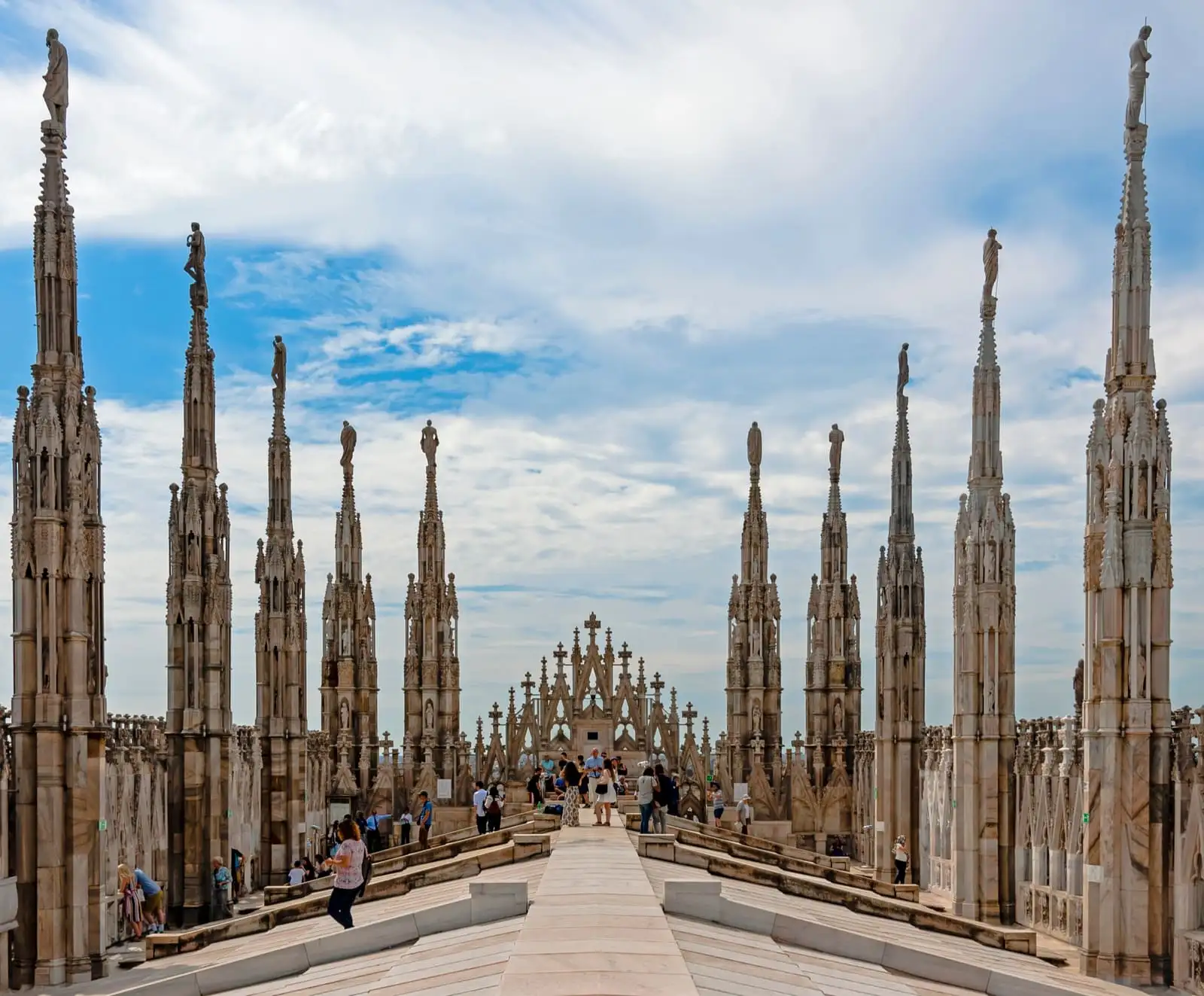

The marble walkways and spires on the rooftop terraces.
Above it all stands the Madonnina, a gilded copper statue of the Virgin by Giuseppe Perego, placed on the main spire in the last days of December 1774. During the Second World War it was covered with a grey-green cloth from August 1939 to May 1945 so it would not guide bombers. In 1848, during the uprising against Austrian rule known as the Five Days, rebels raised the Italian tricolour on it, and the flag still flies beside it on solemn religious and national occasions.
Rooftop-only tickets cost €16 by stairs or €18 by lift. The Duomo tickets guide compares lift and stairs and the fast-track options.
Duomo Museum and the archaeological area
The Duomo MuseumMap is across the square in Palazzo Reale, at Piazza del Duomo 12. It holds statues, stained glass, tapestries and architectural models from six centuries of building, plus the cathedral treasure. The Sala della Madonnina has Perego’s terracotta models for the statue and the head of his wooden model, carved from a single walnut trunk. The museum is open 10am to 7pm and closed on Wednesdays, and it is included in the €10 Duomo + Museum ticket.
Under the square, the archaeological area shows the remains of the old basilica of Santa Tecla and the Baptistery of San Giovanni alle Fonti, built in 378, where Saint Ambrose baptised Augustine in 387. You can still see the octagonal baptismal pool. It needs the Culture Pass (€15) or its own €5 ticket.
Piazza del Duomo
The square in front of the cathedral is public and open at all hours, so you can see the façade at night without a ticket.
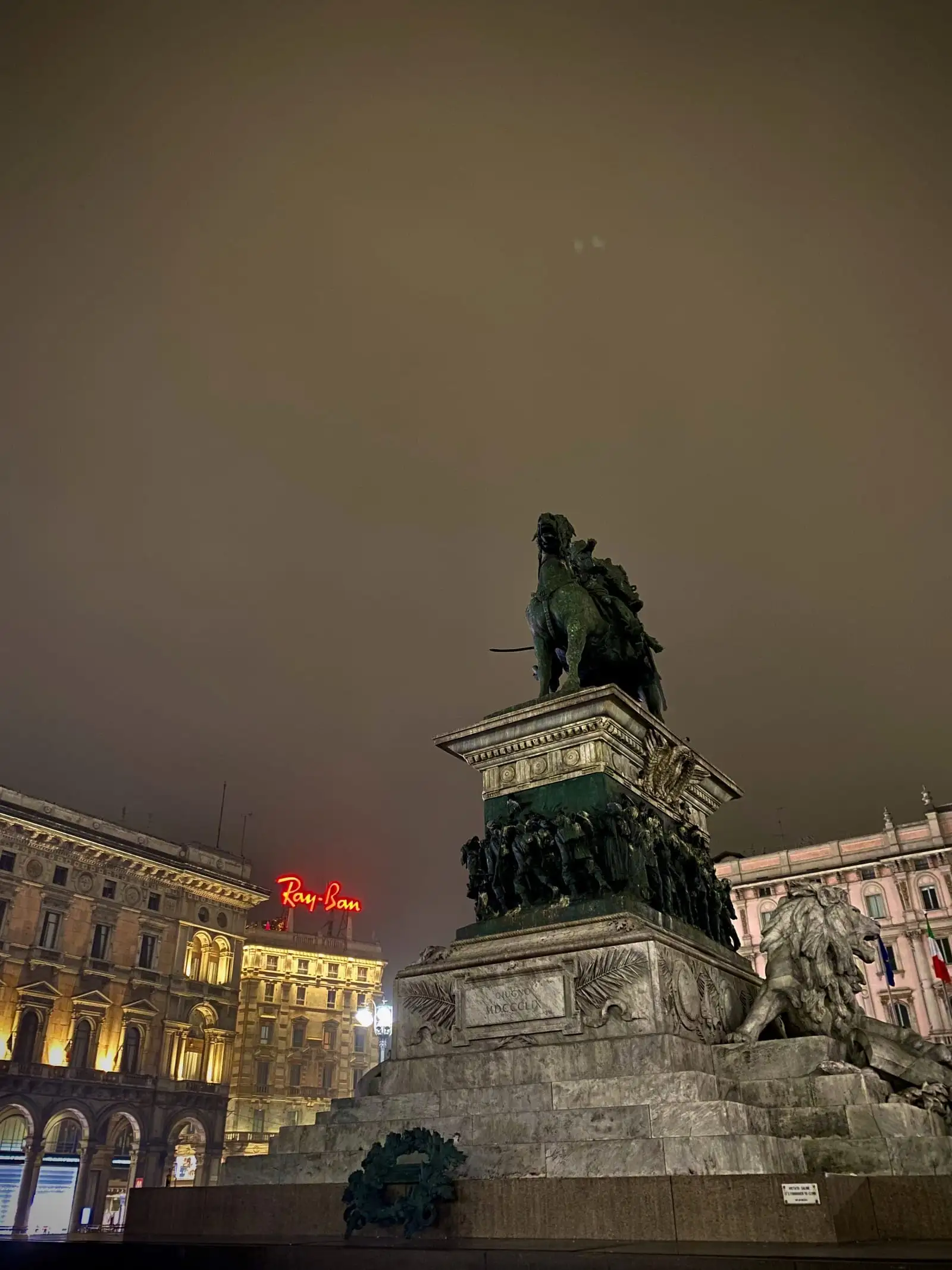
The equestrian statue of Vittorio Emanuele II in the middle of Piazza del Duomo.
- On the north side, the Galleria Vittorio Emanuele IIMap opened in 1867 and was completed in 1878. The glass-roofed arcade is free to walk through at any hour and leads to Piazza della Scala and the opera house.
- On the south side is Palazzo Reale, the former royal palace, which houses the Duomo Museum.
- Next to it, the Museo del NovecentoMap shows 20th-century Italian art in the Arengario building. It costs €10, is closed on Mondays and stays open until 10:30pm on Thursdays.
- In the middle of the square stands the equestrian statue of Vittorio Emanuele II, the first king of united Italy.
- Two minutes west, through Via Mercanti, Piazza dei Mercanti (Palazzo della Ragione)Map was the city’s medieval centre. Under the portico of Palazzo della Ragione, whisper into one corner pillar and a friend at the diagonally opposite pillar will hear you. Try it.
My advice is to eat somewhere else: the places facing the cathedral charge for the view. Our Duomo tickets guide has where I go instead, and why to skip the gelato piled high in the windows nearby.
Tickets, hours and dress code
| What | Details |
|---|---|
| Cathedral and rooftop hours | Daily 9am to 7pm, last entry 6pm |
| Duomo Museum | 10am to 7pm, closed Wednesdays |
| Cathedral + museum | €10 |
| Cathedral + rooftop | €22 by stairs, €26 by lift |
| Where to buy | ticket.duomomilano.it, no online fees |
Every ticket lists the same dress rule: shoulders and legs covered, for the cathedral and the rooftop. In summer carry a scarf or light layer. Hats come off inside. Large bags, food and drink are not allowed, and everyone goes through a security check.
The cathedral runs several free days a year, booked on the official site: the next are 16 October 2026, 4 November 2026, 2 February 2027 and 18 March 2027. If you want someone to walk you through the art and history, guided Duomo tours usually include the rooftop; check whether they go up by lift or stairs.
Going to Mass
Entering to pray or attend Mass is free and does not need a ticket. Worshippers use the side door in the transept from 6:50am to 8:30am and the north door of the façade from 8am to 7pm (last access 6pm). You cannot sightsee on this entry. Masses are held several times a day, and on Sundays the 11am Mass is celebrated in Latin by the cathedral chapter. The schedule is on the Duomo’s liturgy page and can change.
How long to spend at the Duomo
The official minimum visit times are 60 minutes for the cathedral and museum and 120 minutes once you add the rooftop. With the archaeological area and a walk around the square, plan on half a day. Go before 10am or after 4pm if you can: at midday in summer the terraces have no shade.
Getting there and staying nearby
Duomo station, on the red M1 and yellow M3 lines, opens onto the square. From Milano Centrale it is four stops on the M3; our Milano Centrale guide shows how to find the metro from the platforms.
The Duomo is the obvious first stop on a short trip. The one day in Milan itinerary starts with a 9am cathedral slot, and the 2 days in Milan itinerary spreads the main sights over a weekend. Leonardo’s Last Supper painting is four stops away on the M1 and needs booking weeks ahead, so plan that first.
Hotels around the square are the most expensive in the city, but you can walk to the 9am opening. Our best hotels in Milan guide lists options near the Duomo, and you can check hotels near the Duomo on Booking.com for your dates.
Frequently asked questions
How old is Milan Cathedral?
Construction began in 1386, and the high altar was consecrated in 1418. The façade was only completed between 1807 and 1813, and its doors were added between 1909 and 1965.
Is it free to go inside Milan Cathedral?
Sightseeing needs a ticket, from €10 for the cathedral and Duomo Museum. Entry to pray or attend Mass is free through separate doors every day, but you cannot tour the cathedral on that entry.
What should I wear to the Duomo in Milan?
Shoulders and legs must be covered for both the cathedral and the rooftop. Bring a scarf or light layer in summer, and take your hat off inside.
How long do you need to visit Milan Cathedral?
The official guide is at least 60 minutes for the cathedral and museum, and at least 2 hours if you add the rooftop. Half a day covers the whole complex, including the archaeological area.
Why is the Duomo so famous?
It is the largest and most complex Gothic building in Italy, built in pink-streaked Candoglia marble over almost six centuries, with 135 spires and more than 3,400 statues. You can also walk on its roof.
What is the gold statue on top of Milan Cathedral?
The Madonnina, a gilded copper statue of the Virgin Mary placed on the highest spire in December 1774. With it the cathedral reaches 108.5 metres.
When is the Duomo open?
The cathedral and the rooftop are open every day from 9am to 7pm, with last entry at 6pm. The Duomo Museum opens 10am to 7pm and is closed on Wednesdays.