Quick answer
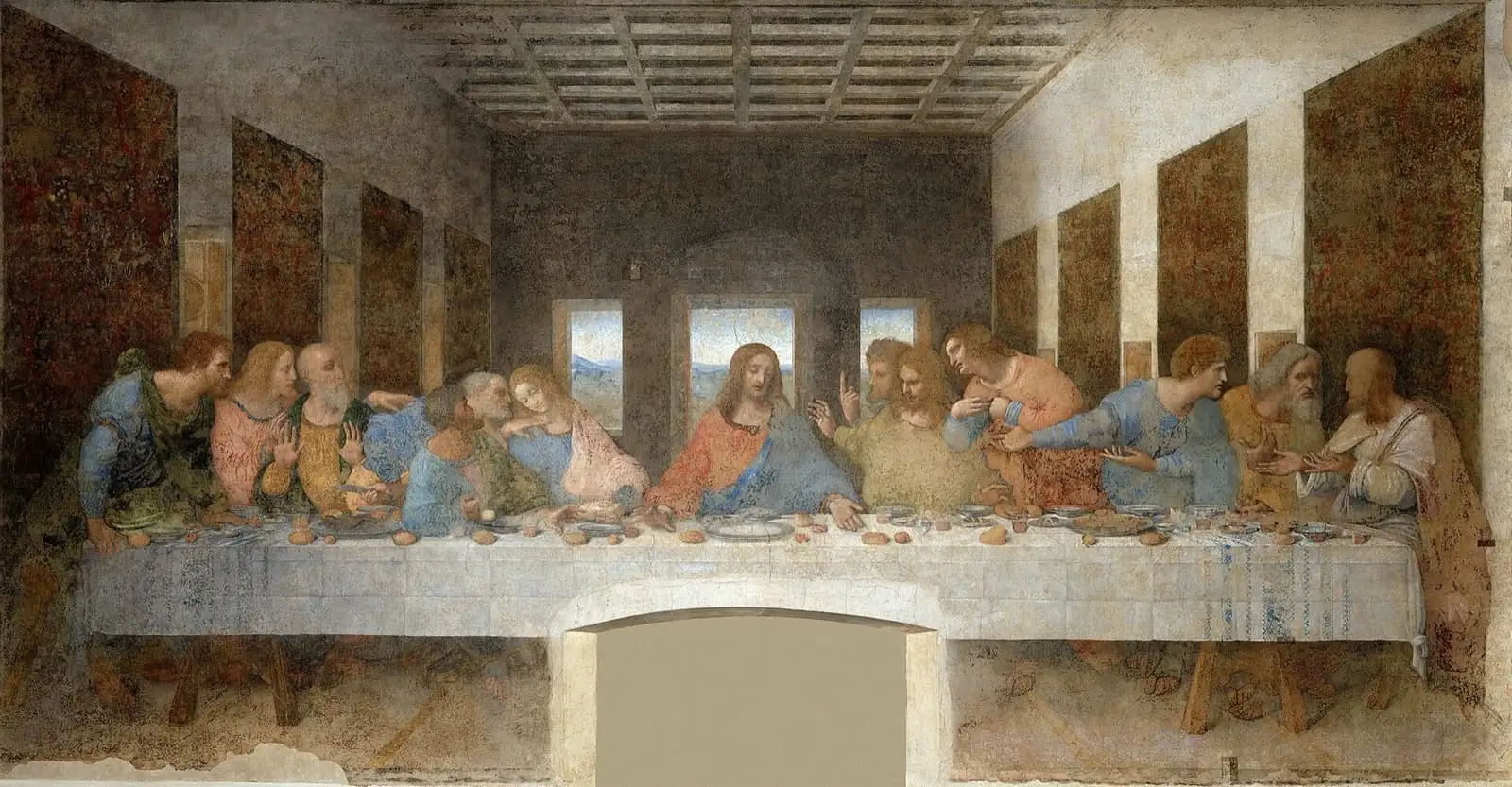
The Last Supper is a wall painting by Leonardo da Vinci, made between about 1494 and 1498 on the end wall of the dining hall of Santa Maria delle Grazie, in Milan. It is still there, measures 4.6 by 8.8 metres and shows the apostles reacting as Jesus says one of them will betray him. To see it you need a timed ticket (€15) booked in advance.
Dates and figures below come from the Last Supper Museum, which the Pinacoteca di Brera has run since December 2024. Ticket details were checked on 5 October 2026.
Where is the Last Supper painting
The painting has never left the wall Leonardo painted it on: the north wall of the refectory, the room where the Dominican friars of Santa Maria delle GrazieMap ate their meals. In Italian the room is called the Cenacolo, which is why you will see the painting called the Cenacolo Vinciano.
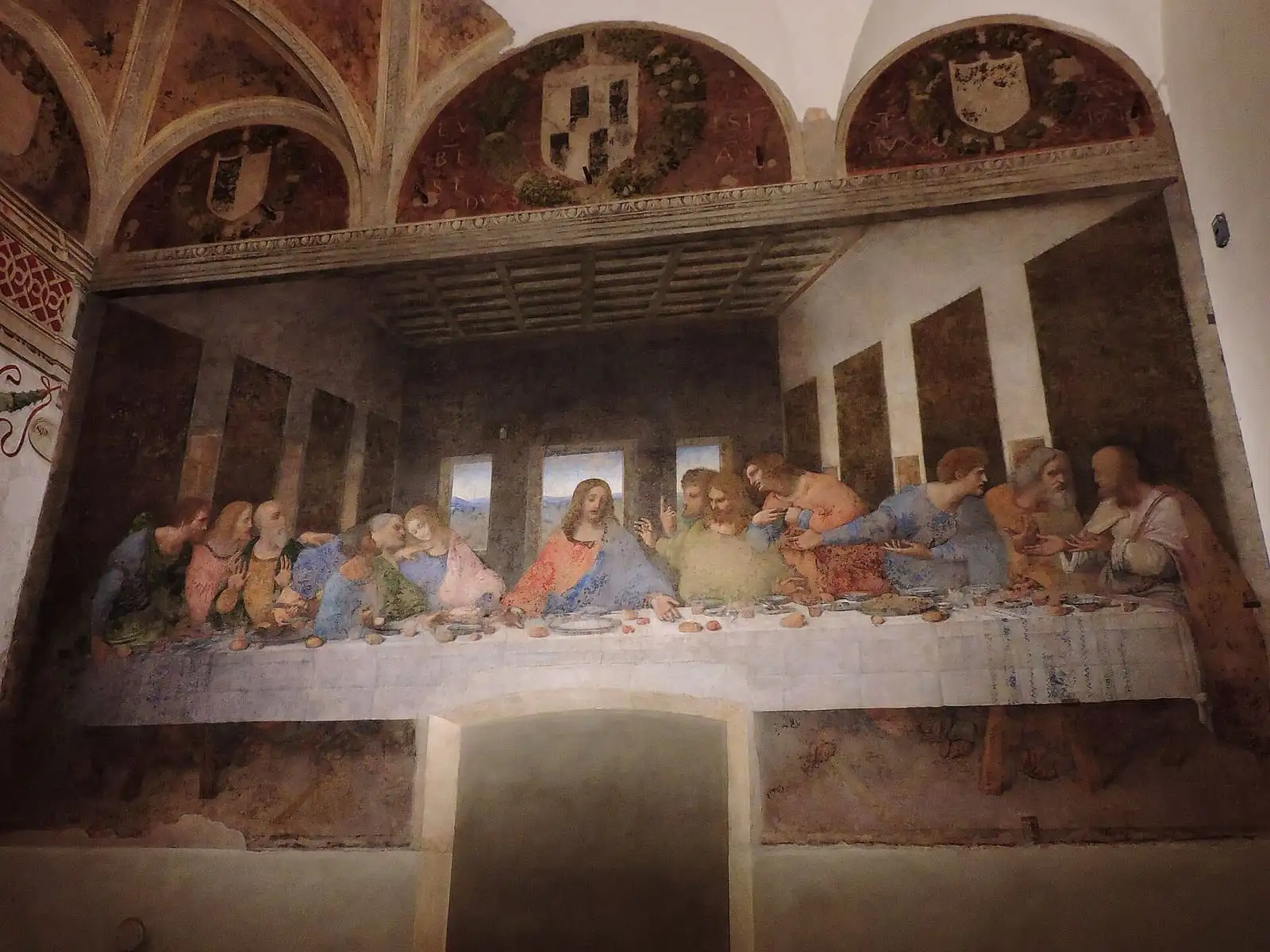
.jpg)
The refectory end wall, with the Last Supper below three painted lunettes.
Today the refectory is a small museum, the Museo del Cenacolo VincianoMap, at Piazza di Santa Maria delle Grazie 2, in the west of central Milan. The opposite wall holds a Crucifixion by Giovanni Donato Montorfano, painted in true fresco and in much better condition. Leonardo probably added portraits of Ludovico Sforza, his wife Beatrice d’Este and their sons along its bottom edge.
Since 1980 the church, the convent and the Last Supper together have been a UNESCO World Heritage Site.
Who painted the Last Supper, and when
Leonardo da Vinci painted it for Ludovico Sforza, known as il Moro, the ruler of Milan. Leonardo had arrived in Milan in 1482 and worked at Ludovico’s court until 1499. Ludovico wanted Santa Maria delle Grazie as his family’s burial church: he gave Bramante the rebuilding of its east end and asked Leonardo for a painting of Christ at the Last Supper with the twelve apostles for the friars’ dining hall.
The museum’s own pages give two starting dates. Its main text says Leonardo worked on it from 1494 to the beginning of 1498, and its catalogue entry says 1495 to 1498. Either way it took three to four years, and Leonardo was in his early forties.
During his years in Milan he also painted the Lady with an Ermine (now in Kraków) and, in 1498, the Sala delle Asse in Sforza CastleMap, which is closed for restoration in 2026 (our Sforza Castle guide has the latest).
How big is the Last Supper
| Detail | Figure |
|---|---|
| Size | 460 x 880 cm (about 15 x 29 ft) |
| Technique | Tempera on dry plaster (a secco) |
| Dates | about 1494 to 1498 |
| Commissioned by | Ludovico Sforza, Duke of Milan |
| Location | Refectory of Santa Maria delle Grazie, Milan |
| Last restoration | 1977 to 1999 |
The painting fills the whole end wall. The vanishing point of the perspective sits 4 metres above the floor, at Christ’s right temple, so the painted room reads as an extension of the real one when you stand inside.
How Leonardo painted it
Wall paintings in Leonardo’s time were usually frescoes: the painter works fast on wet plaster, a patch a day, and cannot change anything once it dries. That did not suit Leonardo, who worked slowly, went back over finished areas and worked on the whole surface at once.
So he painted on the dry wall as if it were a wooden panel. He spread a white preparatory layer and painted over it with tempera made with egg yolk. This gave him intense colours and fine effects of light, but the paint sat on top of the wall instead of soaking into it.
Leonardo also matched the painted light to the real room. The light in the picture falls from the left, where the refectory’s real windows are, and the windows behind Christ open onto blue mountains, an example of what Leonardo called aerial perspective: distant things look bluer.
What the Last Supper shows: who is who
Leonardo chose the moment right after Jesus tells the apostles that one of them will betray him. Each apostle reacts differently, and the museum lists anger, fear, amazement and sorrow among the emotions. Leonardo called these the “motions of the soul”. Christ sits at the centre, his outline forming a triangle, with the twelve apostles in four groups of three.
Left to right, in the groups the museum describes:
| Group | Apostles | What they are doing |
|---|---|---|
| Far left | Bartholomew, James the Lesser, Andrew | Bartholomew springs to his feet; Andrew raises his hands |
| Inner left | Peter, Judas, John | Peter holds a knife and urges John to ask who the traitor is; Judas shrinks back, holding the bag of 30 silver coins |
| Centre | Christ | Set apart in a triangular outline |
| Inner right | James the Greater, Thomas, Philip | James throws his arms wide; Thomas raises a finger; Philip stands with his hands on his chest |
| Far right | Matthew, Judas Thaddeus, Simon | Matthew stretches his arms toward Christ while turning to the other two |
The young figure next to Christ is John. The theory that it is Mary Magdalene was popularised by novels such as The Da Vinci Code; the museum names him as John, “the melancholy young man seated next to Christ”.
Why the Last Supper is so damaged
Because the paint never bonded with the wall, it started to come off almost at once. In 1517 a visitor wrote that it was “beginning to decay”. By 1568 Giorgio Vasari could make out little more than a blur, and in 1625 Cardinal Federico Borromeo wrote of falling flakes of paint.
People then made it worse:
- Repainting. The museum records nine restorations from the early 1700s on. Most early restorers repainted whole areas instead of saving what was left.
- The door. In 1652 a door was cut through the bottom of the wall, and Christ’s feet were lost with it.
- Soldiers. Napoleon’s troops used the refectory as a stable.
- The 1943 bombing. An Allied air raid brought down the roof, the vaults and the east wall of the refectory. The Last Supper’s wall had been sandbagged and braced, and it stayed standing, as did Montorfano’s Crucifixion opposite.
The last major restoration, by Pinin Brambilla Barcilon, ran for more than twenty years, from 1977 to 1999. It removed old overpaint to recover what Leonardo had painted himself. The museum is frank about the result: little of the original painting is left, and what you see is as close to it as the restorers could get.
The visiting rules come from the same problem. The room’s air is filtered and monitored, visitors pass through a series of automatic doors that open and close in turn, and only small groups go in.
How to see the Last Supper today
You can only see it with a timed booking, and slots sell out weeks ahead. The key facts:
- A ticket costs €15 and lets you spend 15 minutes in the refectory, with up to 40 people per slot.
- Book on the official site, cenacolovinciano.vivaticket.it. Tickets are released in batches at noon Italian time, with extra tickets every Wednesday at noon for the following week.
- The museum is open Tuesday to Sunday, 8:15am to 7pm (last entry 6:45pm), and closed on Mondays.
- Arrive 30 minutes before your slot with your passport.
- Personal photos without flash are tolerated. Flash and video are not.
Our Last Supper tickets guide explains the release calendar, the €2 youth rate that Americans do not get, and what to do when everything is sold out. When official tickets are gone, the most reliable way in is a guided tour that includes entry; check that the listing says the ticket is included.
The nearest metro stop is Conciliazione on the red M1 line, about five minutes on foot, or Cadorna (M1 and M2). Tram 16 stops outside. From the Duomo it is four stops on the M1.
What to see nearby
The church of Santa Maria delle Grazie next door is open daily, closed to tourists during services. Its east end was rebuilt by Bramante for Ludovico Sforza, who also paid for Leonardo’s painting.
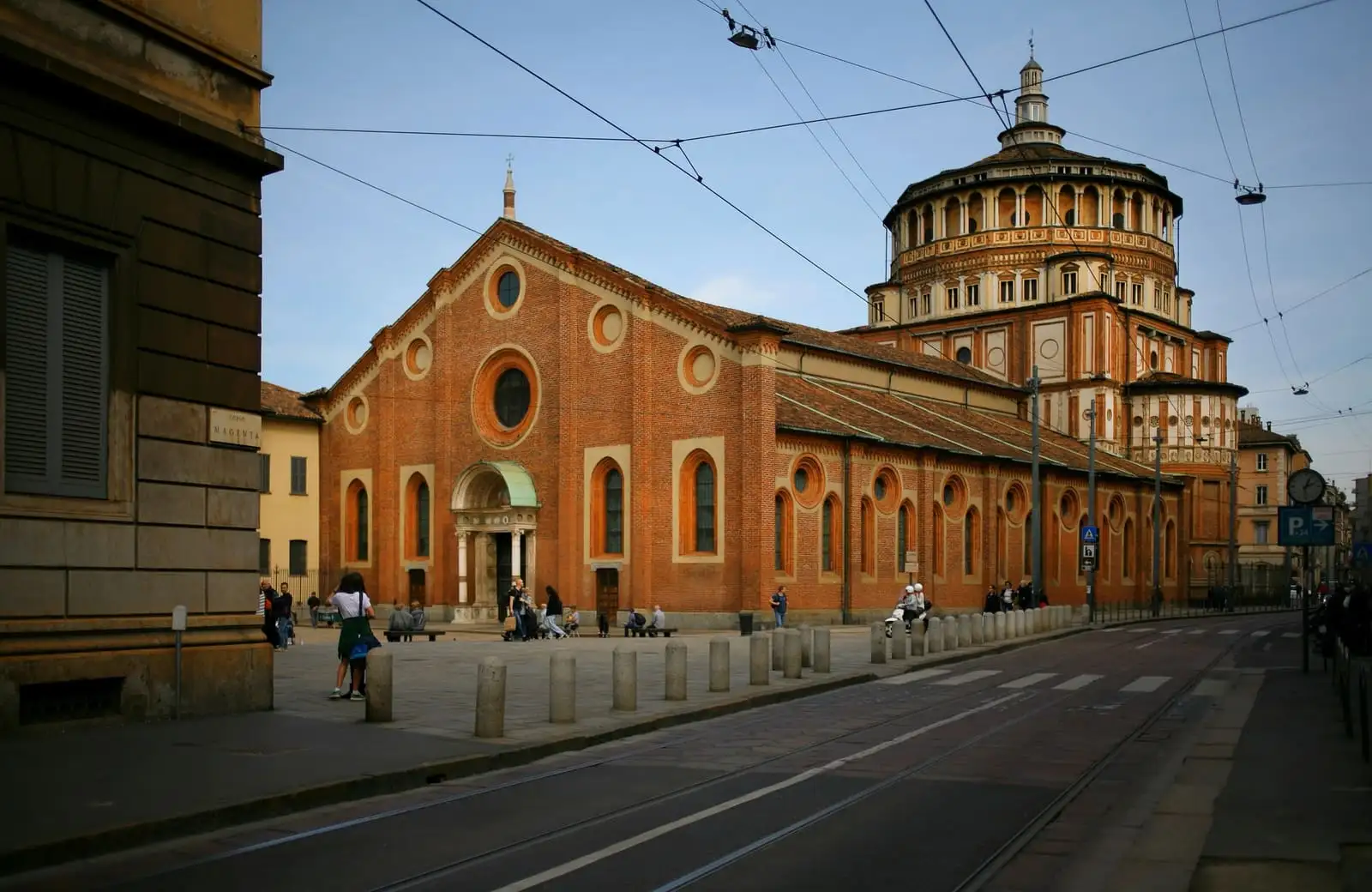

Santa Maria delle Grazie, with the domed east end Bramante built for Ludovico Sforza.
The Last Supper Museum is now run by the Pinacoteca di BreraMap, which also has paintings by Leonardo’s Milanese followers. If you want to plan the painting into a full day with the cathedral, our guide to Milan Cathedral covers what to see there, and the one day in Milan itinerary shows how to fit a Last Supper slot around it. Our list of things to do in Milan has the other sights, with prices and closing days.
Frequently asked questions
Who painted the Last Supper?
Leonardo da Vinci, for Ludovico Sforza, Duke of Milan, who commissioned a painting of Christ at the Last Supper with the twelve apostles for the dining hall of the Santa Maria delle Grazie convent.
Where is the Last Supper painting?
In Milan, Italy, on the north wall of the old refectory of Santa Maria delle Grazie, where Leonardo painted it. The room is now the Museo del Cenacolo Vinciano, at Piazza di Santa Maria delle Grazie 2.
How big is the Last Supper?
It measures 460 by 880 centimetres, about 15 feet high and 29 feet wide, and covers the whole end wall of the room. Christ's head is about 4 metres above the floor.
Why is the Last Supper so damaged?
Leonardo painted on dry plaster with tempera instead of using true fresco, so the paint never bonded with the wall and began flaking within a few years. Clumsy repaints, a door cut through the bottom in 1652 and the 1943 bombing of the refectory added to the damage.
Is Mary Magdalene in the Last Supper?
The museum identifies the young figure seated at Christ's right, on the left as you look at the painting, as the apostle John. The Mary Magdalene idea comes from novels and popular theories.
Can you just walk in to see the Last Supper?
No. Every visitor needs a booking, including children and people with free tickets. A standard ticket costs €15 and gives you 15 minutes in the room.
How long did it take Leonardo to paint the Last Supper?
About three to four years. The museum dates it to between 1494 or 1495 and the beginning of 1498.